


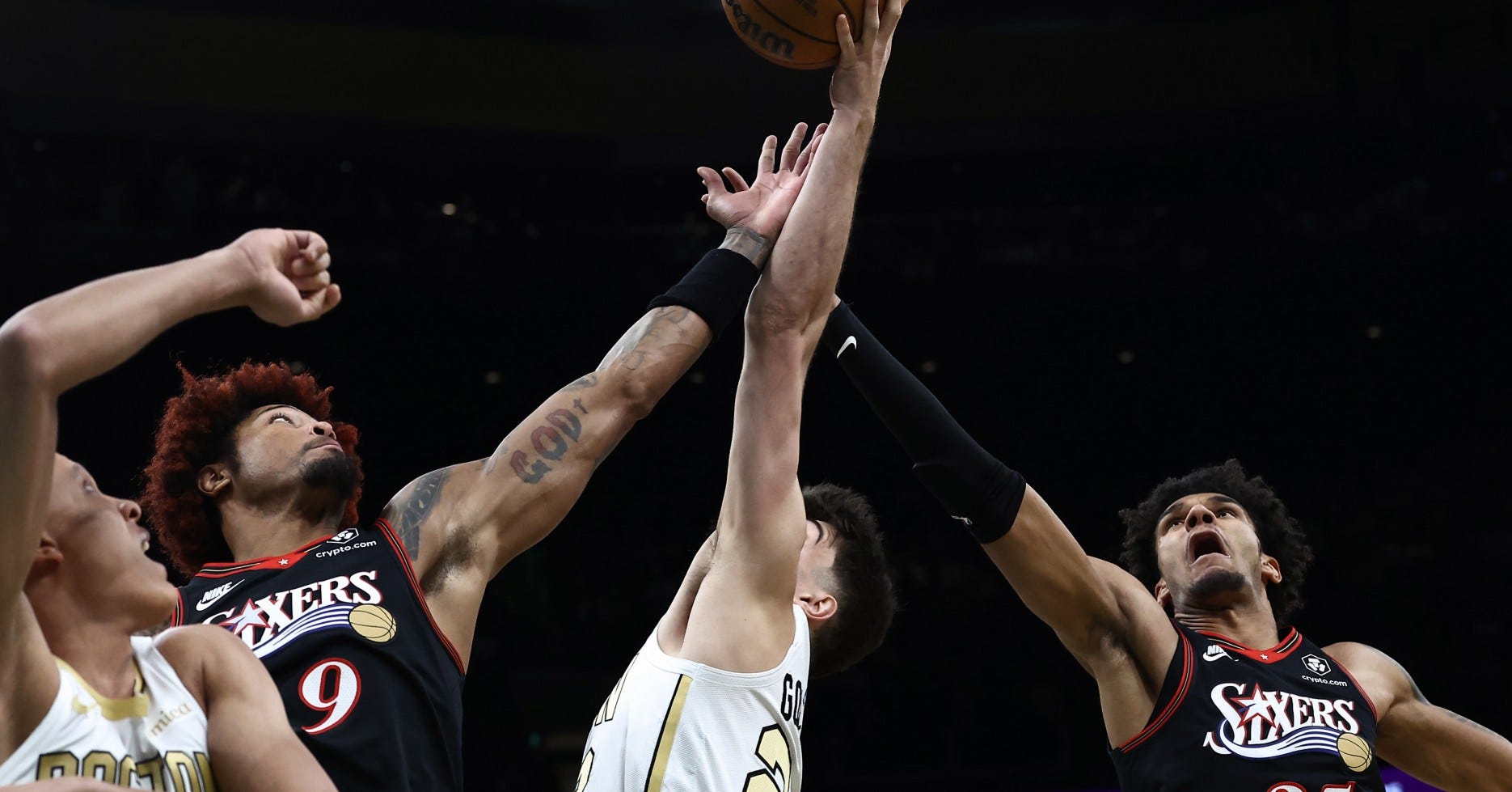
The Sixers continue the battle to escape the play-in, and they’ve been more or less healthy for the first time in a while (knock on wood). That leaves Nick Nurse with a deceptively simple question: Who should be the team’s fifth starter alongside Joel Embiid, Tyrese Maxey, Paul George, and VJ Edgecombe (henceforth the team’s “core four”)?
There are two main options, with both Dominick Barlow and Kelly Oubre Jr. seeing time throughout the year to close out the lineup. And while that might sound like a simple either-or decision on the surface, the reality is a bit messier once you dig into the details.
For starters, injuries have cost us the ability to see these lineups consistently. The most-used Sixers lineup — Barlow with the core four — has just 396 non-garbage time possessions, or roughly four games’ worth of data. The Oubre version is even thinner at 220 possessions, or just over two games. None of the other combinations even clear the 100-possession threshold typically needed for lineup evaluation. For reference, several teams are starting to have lineups with over 1000 possessions. It (almost) makes you feel a little bad for Nick Nurse.
Now that doesn’t mean we can’t evaluate them at all; we just need to be a bit more careful with how we approach the context around the numbers. And even in the minutes that we do have, none of these lineups has been world-beating.

The core four with Barlow sit at a mediocre +1.2 points per 100 possessions, and the core four with Oubre are similarly uninspiring at just +2.5 points per 100 possessions. Those are still better than the overall Sixers squad — who still suffer the ignoble title of having a negative net rating as a prospective playoff team — but are distinctly poor when compared to other five-man units across the NBA.
Unfortunately, while neither option has been particularly impressive, we have to choose one of them. We can’t just trot out the core four and call it a day. So how do we differentiate between the two? It all comes down to tradeoffs and what you’re willing to live with.
To this point in the year, Barlow in the starting lineup has been much stronger defensively than the Oubre lineup, giving up a 112.7 defensive rating in non-garbage time (60th percentile), but not quite as successful on offense, with just a 113.9 offensive rating (32nd percentile).
A lot of that lineup’s defensive success stems from better defensive rebounding — though “better” is just the 39th percentile; it’s still the Sixers, after all — and limiting fouls. They have also been much more effective at keeping teams off the 3-point line and forcing a high volume of midrange looks, perhaps due to Barlow’s switchability.
However, offensively, the Barlow lineup can struggle to make shots. Opponents clog the paint, helping off Barlow’s lack of perimeter shooting — 3 of 18 on threes since the all-star break, and zero since March 15th — which shrinks the space for everyone else. In a playoff setting, where defenses are more deliberate about exploiting weak links, that pressure point is only going to get louder.
On the flip side, Oubre in the starting lineup — which is what Nurse has gone to in the last two games — has been much more impactful offensively, posting a 122.3 offensive rating in their minutes, while struggling more defensively, posting a 119.7 defensive rating.
The key driver of the offensive success has been 3-point shooting, with the Oubre starting lineup hitting 40.8% of their threes. Their halfcourt execution overall also sees a big jump, ranking in the 86th percentile among all 5-man lineups. Stick four shooters around Joel and you’ll have success on offense, who knew!
They lose much of the offensive rebounding volume and putback efficiency that Barlow provides, but when they can space the floor effectively, it cures all offensive ailments. Oubre in particular has been excellent when playing off of the big guy, hitting over 48% of his triples when sharing the floor with Joel overall. There’s some obvious regression risk baked into that number, but there’s also enough shooting around him to soften the drop if it comes.

Defensively, the issues will sound familiar to every Sixers fan who’s watched a game this year: rebounding and transition.
Their defensive rebounding has predictably struggled with Oubre as our fifth, allowing opponents to get back over one in every three misses (12th percentile). However, not only are they giving up a high rate of offensive rebounds, but they are also getting absolutely shredded on second-chance opportunities, sitting in the 0th percentile (a.k.a. the worst five-man lineup in the league) and giving up a 214.3 offensive rating on putbacks. Now obviously, there are some small sample size caveats here where the opponent scoring rate is highly unlikely to stay that high. But without Barlow’s (still just mediocre) defensive rebounding at the 4, this lineup has no way to end possessions.
The same lackadaisical approach extends to transition play, where they are once again defending at the level of the worst five-man lineup in the league (not a phrase I should ever be typing twice in an article).

So where does that leave us? Right back at the tradeoff. Who you want to start comes down to what aspects of the team performance you want to prioritize — offense and shooting with Oubre, or defense and rebounding with Barlow?
My personal opinion is they should start with Barlow, both because our rebounding is so lackluster without him and because of his burgeoning partnership with Joel. But Nurse can rely on the hot hand in each matchup to decide how he wants to close the game.
Regardless of who they choose, the starting five Nurse ultimately plans to go with needs to get consistent minutes as much as possible over the next three games so they can enter the playoffs with some confidence. There’s no perfect answer here, but the Sixers need to decide which version of themselves they trust when it matters.

The spurs loss, outside of the Maxey stinker, is the shining example for why Kelly can’t just be the starter. If he’s not creating space, hitting his threes, I just don’t want to see him on the floor.