

Who Benefits Most From Joel and PG Being Back?
Beckett breaks down which players on the Sixers are helped the most from the returns of the two veteran All-Stars to the lineup.

Who is this team?
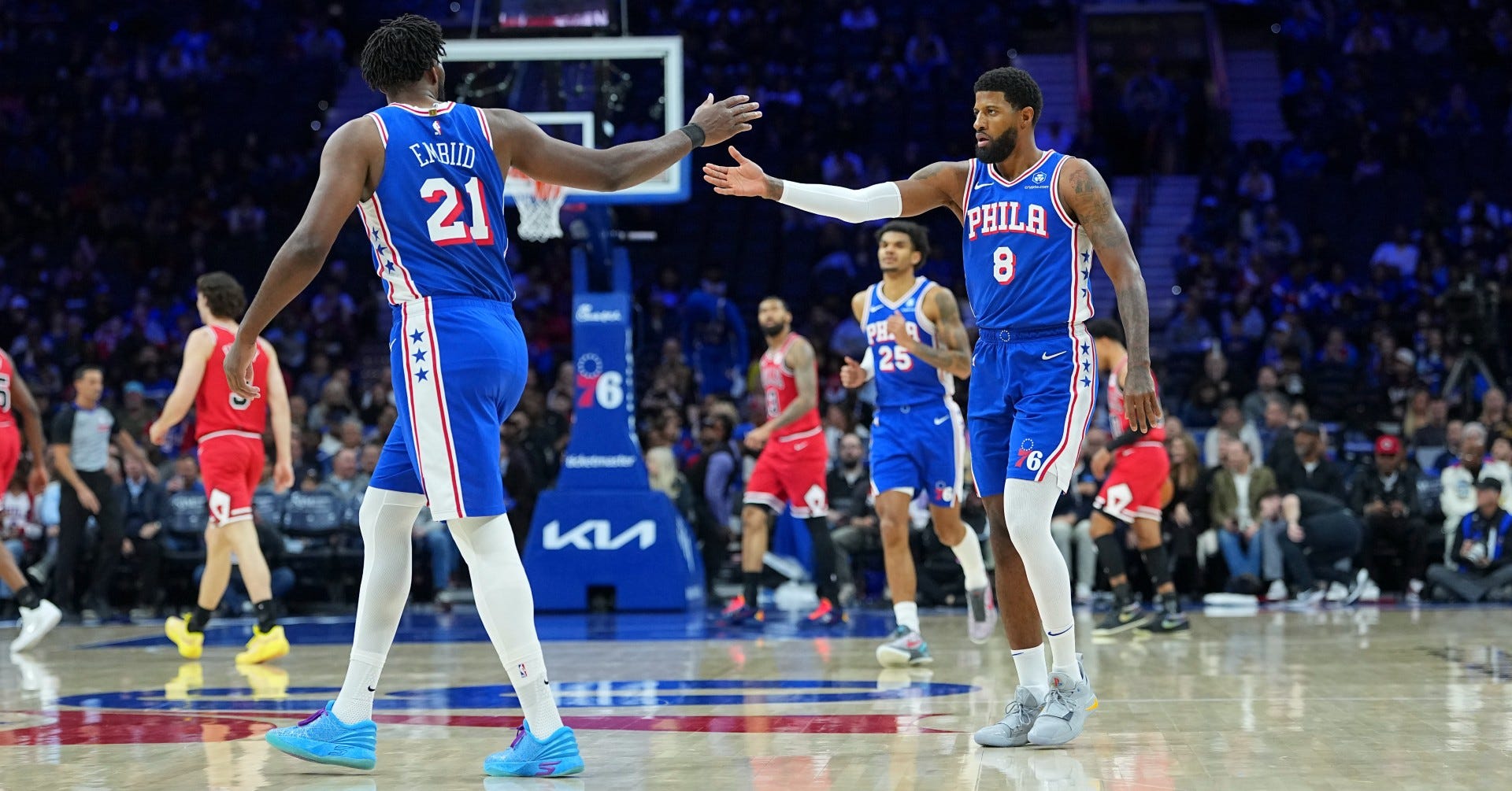
The Sixers put together two professional wins over the Bulls and Hornets, and the vibes are right back to an all-time high. We’re officially in the “tease” period, as Spike and Mike called it on the most recent pod. Joel Embiid and Paul George returning make the Sixers immediately look like an actual NBA basketball team — a notable shift from whatever farce we were throwing out for the few weeks before that.
They clearly have an impact on their own, but is there any additional change they’re causing on the players around them? And if so, who are they impacting the most? That’s where things start to get a bit more interesting than the obvious “they’re good players” takeaway.
Let’s start with the obvious point: the Sixers are simply better with them on the floor. This is fairly clear to anyone who has paid a modicum of attention to the Sixers at any point, but for those who doubt the true veracity of that statement, please see this article from earlier in the season. If you’re still doubtful, consider that the Sixers are +8.0 points per 100 possessions better with Joel on the floor and +9.4 better with PG on the floor (his defensive impact is real!). This extends to any combination of the two, with an excellent statistical profile together, and each holding a positive net rating when having to carry the team on their own. That may be more surprising for PG, but every single player he has played with on the Sixers has won their minutes by more with him than without him.
So yes, the baseline takeaway is simple: the Sixers are better when their stars play. The more interesting question is what happens beyond that. Who else are they helping?

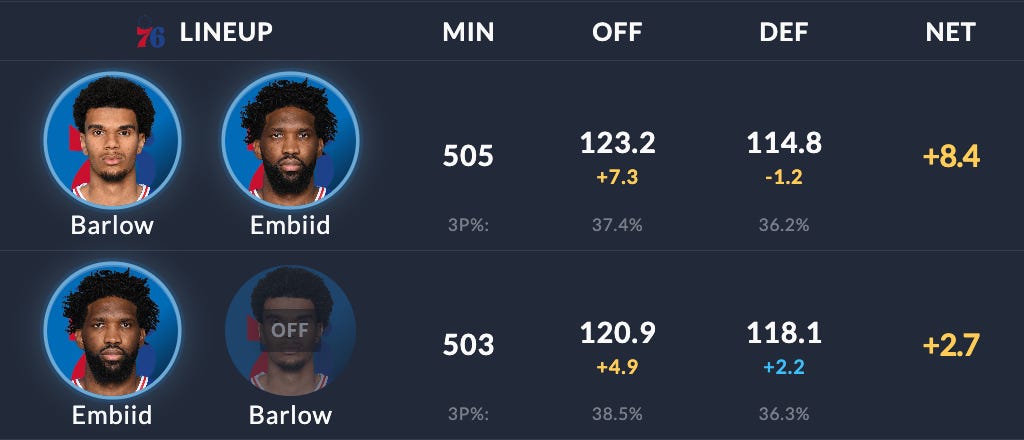
Dominick Barlow, for one, sticks out as being far better playing with Joel and PG than not. He is the only player whose scoring doesn’t fall significantly with the 2nd- and 3rd-leading scorers on the team added to the mix, averaging right around 12 points per 75 possessions with or without them. But the way he gets those points is far more impactful, particularly with Joel, as Barlow’s efficiency spikes way up, with a 6.1 percentage point better TS% with Joel than without.
The reason for that is his rim pressure, taking over 71% of his shots at the rim with Joel on the floor compared to just 46% when he’s off — given Barlow’s much higher efficiency at the rim compared to on 3’s or midrange looks, it’s easy to see how his productivity takes a jump. It makes a ton of sense why this is the case, as Joel adds far more spacing with his midrange and 3-point willingness than Andre Drummond or Adem Bona, who clog up the paint more. Joel also seems to have a great feel for Barlow’s off-ball cutting when he gets doubled, which actually lets him leverage the space into points.
In addition, without anyone else taking up space at the rim, Barlow’s individual offensive rebounding rate nearly doubles, crashing the rim far more aggressively into the empty space. We spent the last month or so wondering why Barlow had hit a wall since getting his new contract, and it turns out he was probably just missing Joel.
He appears to have a positive impact on Joel’s minutes too with his interior activity (see the lineup graphic below), which also makes sense given Joel’s clear decrease in interior activity. Pairing them together more consistently could provide a boost to both of their minutes — and to be fair, Kate and Alaa did mention Nick Nurse liked this pairing on the broadcast yesterday, so he might be on it.
VJ Edgecombe is another excellent example of a player who gets better with our stars back. Without having to carry the offense for stretches, he can utilize his athleticism and impressive game feel to attack off the advantages Joel and (to a lesser extent) PG create with their gravity.
It shows up in his efficiency, with an 8.8 percentage point increase in TS% with Joel and a 6.7 percentage point increase with PG. Most of that once again comes from leveraging the space Joel and PG provide, as VJ gets to the rim more frequently with either of them on the court, and he is also finishing those chances much better with Joel on the floor — 67.1% rim finishing with Joel compared to 53.2% without.

The looks he gets are simpler as well, as VJ cuts his off-the-dribble midrange volume nearly in half and sees a notable increase in the percentage of his baskets that are assisted. His volume falls off somewhat in the process, which is fairly expected given the heliocentrism of our stars, but it’s gotten to a point where it feels like every shot he takes as an auxiliary piece is going in at this point. As impressively far ahead of schedule as VJ has been in his rookie year, this off-ball role is a much cleaner fit with his current skillset, allowing him to attack advantages and leverage spacing instead of having to create his own looks in a more bogged-down offense.
And in a lot of ways, that’s the common thread here. Joel and PG don’t just raise the team’s ceiling — they simplify the game for everyone else on the floor.
When you’re watching the basketball slop that the Sixers have provided us for the last month, it’s easy to simply accept that as just who the team is, and forget how critical Joel and PG are to the team’s success. Not just through their own individual impact, but also through their impact on the players around them.

Their spacing in particular opens up a massive amount of offense that simply isn’t available with our more 3-point-averse players on the floor (really makes you wonder how much Mike’s lifelong dream of a floor-spacing big could help). Barlow and VJ are the clearest examples of that impact, but throw on any Sixers game and you’ll see the shift in the way Joel and PG warp the court for others.
I won’t make any declarative proclamations about the playoffs or anything else, but if they’ve somehow fully made it past the most recent injury bug (or PED bug in PG’s case) — a statement I am already regretting typing out — this version of the Sixers has a chance to be at least competitive and entertaining. And that’s an outcome I am more than happy to live with.
 | A guest post by
|
Good analysis… a couple eye test thoughts to add to your data:
#1. Despite the gritty and clutch comeback last night, I came away with mixed thoughts on Joel… as you rightly point out, his gravity opens up so much for rest of team … yet his great moments are mixed with so many clumsy passes and clunky drives into the paint… VJ saved him on one, refs give him fouls that would otherwise be TOs… but this does not bode well for playoff success against even better teams (as last 8 seasons have demonstrated)
#2. I don’t have an answer but can see a not too distant future where JoJo is a 4th option behind Maxey, PG and VJ… and that team, also to your point, could be really fun to watch… and potentially be more successful in playoffs than we even expect..
I would actually love if you made some more "declarative proclamations." It's funny to me that data dudes so rarely make predictions, despite having the actual knowledge and skill to do so in an informed way. It's cool to learn the numerical representation of more space=everyone plays better, but it would be even cooler to see like... how much higher would the team's offensive rating get if Joel stays healthy for the rest of the season + Nick Nurse is smart enough to play Barlow with him + draw up/advise more weak-side/backdoor cuts. IDK if that makes sense because I'm not an analytics person but it's the type of stuff I would find super compelling.