

We Should Have Known All Along
Beckett reflects on the most Sixers season imaginable: the one where they finally gave us hope again just so they could snatch it away.

The one time. The one time I actually didn’t have expectations going into a season.
The Sixers were coming off a 24-58 season of absolute misery that somehow earned them the gem that is Valdez Drexel Edgecombe Jr. For once, the season felt untethered from the usual pressure. No one looked at this team like a contender. No one even pondered the possibility of a playoff run. We were just happy to be there and see what a young and exciting backcourt of Tyrese Maxey, VJ, and Jared McCain (long may he reign) could mean for the future.
And we got exactly that. VJ exploded for 34 points in an opening-night win in TD Garden, earning “Boston Strangler” comps to the great Andrew Toney in his first-ever NBA game. It didn’t stop there either. Throughout the season, we got flashes of what VJ Maxx (we still desperately need a better nickname) could become with their absurd open-floor speed and athleticism.
There were highlights and lowlights that come with any Sixers season, with Paul George’s 25-game suspension and Joel Embiid’s injury-plagued moments of brilliance leading the way. Still, through it all, I managed to keep a lid on any semblance of attachment to playoff success. I even wrote an entire piece dedicated to telling as many people as possible not to fall for it. Even at their best, the Sixers did not look like a team that fit the mold of a real playoff contender, no matter how many flashes they showed.
But then they went and beat the Celtics.

I managed to keep my expectations down at first. I knew Boston was a brutal matchup before the series even started, and the 3-1 hole they dug themselves into did absolutely nothing to change that sentiment. I loved VJ’s and Maxey’s performances in Game 2 and was content with the playoff experience we had gotten for our exciting young rookie. Game 5 felt like a flash in the pan of something greater with the defensive close in the fourth quarter, but even that I brushed aside as outlier shooting luck from Boston. I absolutely abhorred the thought of losing to the Celtics again, but I knew this wasn’t the year, and I could live with the outcome.
Game 6 though… Game 6 showed the vision of what this team could truly be.
The talent was obvious, sure, but more importantly, they finally matched it with the effort and intensity required to survive playoff basketball. For stretches, they looked like a team that could actually compete with anyone in the league when fully locked in. And that was the shocking part. The physicality. The desperation. The willingness to throw themselves into every possession in a way we honestly haven’t consistently seen over the course of the entire Process Era. I didn’t fully buy in — how could I after years of disappointment every time I let myself believe — but it started taking actual effort not to get swept up in it again.
Which brings me to the first thing I probably should have seen coming in retrospect: the Sixers actually won.
The dreaded Celtics were finally vanquished. The Sixers beat a genuinely good playoff team for the first time in 15 years. All it took was none of us expecting it — “a watched pot never boils” and all that. We were just there for the ride, enjoying the little things, and somehow the team responded with the first 3-1 comeback in franchise history.
For a brief moment, the weight was gone. The cynicism disappeared. The jokes disappeared. We weren’t waiting for the collapse anymore because they had already survived the part where the collapse was supposed to happen.

And naturally, that’s exactly when things became dangerous again. Because once the expectations came back, the Sixers became the Sixers again too.
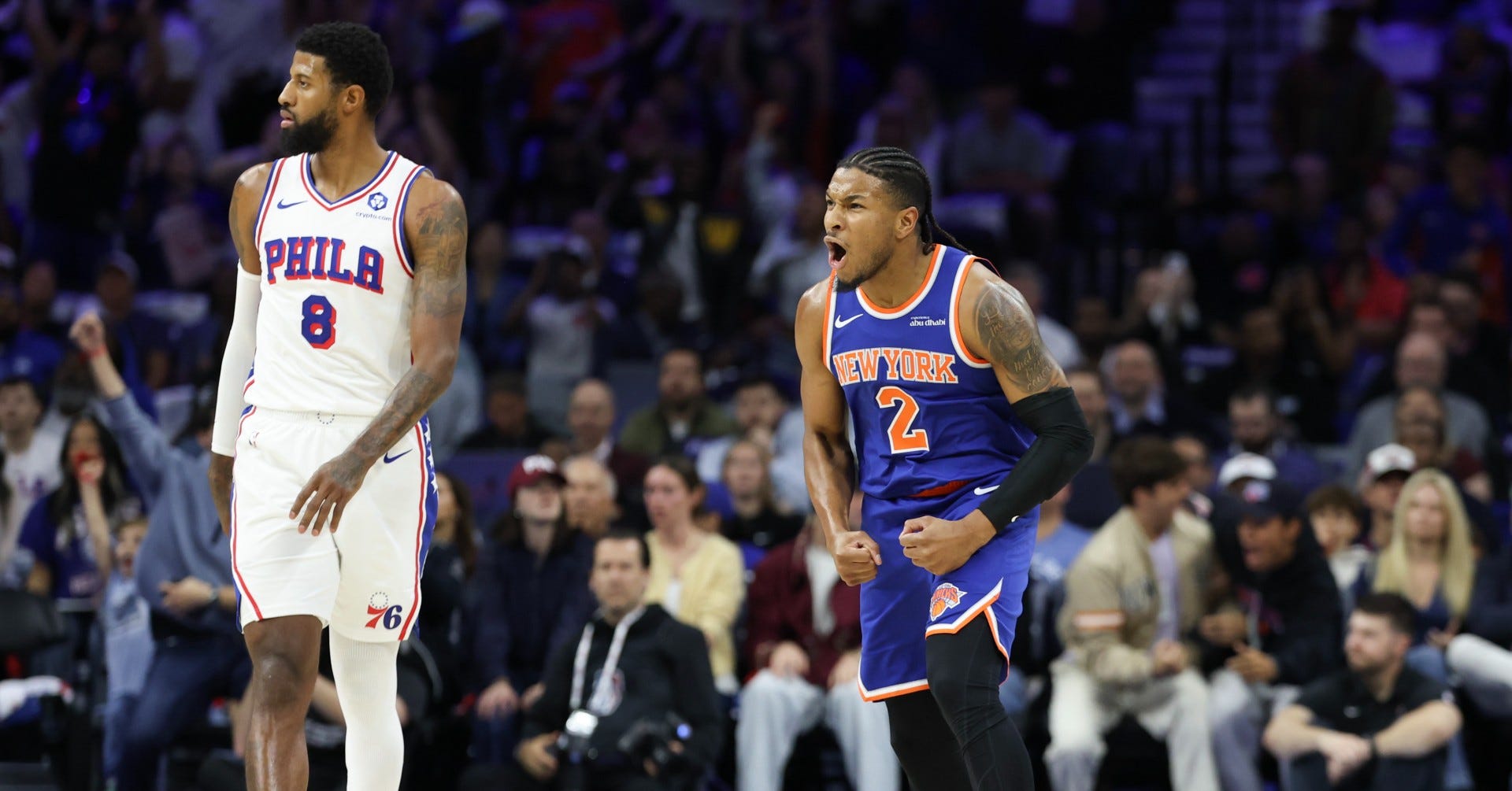
With a trip to the conference finals on the line, the East more open than it has been in years, and belief fully creeping back into the fanbase, the Sixers reverted right back to who we thought they were. Not only were they summarily swept by the Knicks, but the effort they put forth was bad enough that there should have been an entire podcast episode of Mike’s “Embarrassed” song on loop. New York was so dismissive about the matchup that they effectively turned Xfinity Mobile Arena into “Madison Square Garden East,” and by the end of the series Josh Hart was openly questioning the sports fandom of Philadelphia as a whole. The series went so poorly that the Sixers organization went from “maybe this core deserves another shot” to firing Daryl Morey in the span of about ten days.

The cruel irony of this season is that the Sixers finally succeeded the moment nobody expected them to. The pressure disappeared, the fear disappeared, and the team responded with the biggest playoff breakthrough of the era. But the second expectations returned, so did all the old habits. Maybe that’s a coincidence. Or maybe this franchise has spent the last decade proving it handles freedom a lot better than pressure.
The lesson here may be simple: never trust the Sixers once they give you a reason to trust them. Enjoy the vibes, enjoy the chaos, enjoy VJ doing something absurd in transition, but the second you start opening Basketball Reference to map out conference finals matchups, the Sixers are more than ready to lose by 30+ on another Mother’s Day elimination game. This team can smell optimism and always knows just how to take advantage.
The one time we went into a season without expectations ended up producing the most emotionally confusing playoff run of the entire Process Era. The Sixers finally beat the Celtics, reignited belief across the city, and then immediately reminded everyone why we were trying not to believe in the first place. We should have known all along.
 | A guest post by
|
Beckett writes a very good article, but I disagree with(mainly)one point: To me, this is the first time in 25(not 15) years, that the 76ers beat a good team in the playoffs. The Chicago Bulls of 2011-12 somehow captured the top seed in the Eastern Conference, but without both Derrick Rose and Joakim Noah(who got hurt in the 76ers/Bulls series), they were Not a top team.
The teams the 76ers beat in 2001(Pacers,Raptors, Bucks) were not as good as the Spurs or Kings, perhaps, but they were better than the paper-thin 2011-12 Bulls, missing two of their best players.
Ok, this comment is slightly unrelated to a post about the nature of the Sixers' season, but it very much has to do with the literal way the season ended. And it's stat-related so I think replying to The Statman is fitting enough.
I think the nature of the way the current NBA game is played, massively increased 3PA and the attendant variance, has broken people's brains. I think it leads to outcomes that are over-interpreted by viewers and commentators (Spike and Mike included) when really the main answer (though not the only answer) is game to game randomness.
Obviously, what I just said could apply to any NBA game and I've had the thought countless times before. But the final game of the season and the reaction to it brought it to the forefront of my thoughts.
Did the Sixers play well on either end in game four? Nope, not at all. They played badly. But it's also true that the Knicks were shooting over 60% from three on high volume when garbage time set in and the Sixers were shooting well under 30%. Given those conditions, I think even if the Sixers played in an admirable, non-embarrassing way, they still lose by 20. And I think the final score would, in that alternate reality, still have made people assume they played embarrassingly... because what else could explain losing by 20?
But in reality, that's just what happens. If your opponent is setting 3 point shooting records and ~tripling up (no pun intended) your shooting percentage on high volume...you lose! What if you try really really hard though? You lose! What if, instead of being the less talented team, as the Sixers were, you are actually a more talented team who is just cold while your opponent in on fire? You lose!
I know an obvious response to this is, "Well, if you played better (less embarrassing) defense, this kind of slanted outcome wouldn't happen!" And, obviously playing defense is better than not. But it doesn't fix this type of outcome and I will use a fascinating (to me) example to show this:
Steph Curry is probably the greatest shooter of all time. For his career, when left WIDE OPEN (per NBA tracking) he shoots ~49% from three.
So, if instead of a mix of average to good shooters, the game four Knicks were entirely made up of Steph Currys. And, for the entire game, the Sixers failed to contest ANY of their 3PA...you STILL wouldn't expect a shooting outcome like what actually happened in game four! (To say nothing of the other side of equation and the Sixers poor shooting)
And, like, that's just what happens. There are a lot of NBA games! Some are going to be crazy anomalies!
Eventually, my hypothetical New York Stephs would have a game where they hit 80% of their threes! And it wouldn't matter who they were playing or how hard they were playing...they'd win!