

The Problem Was Never Just Morey
The Sixers’ issues run deeper than one executive firing — they stem from an organizational philosophy stuck in the past.

Watching the playoffs right now feels like watching a completely different sport than the basketball the Sixers spent all season trying to play (even beyond the 7’5” alien that Spike and AU seem strangely upset over — yes Victor Wembanyama is that good, he deserves the praise he is getting). Every contender left standing has waves of players who can dribble, pass, shoot, defend, make quick reads, survive physicality and seamlessly slot into whatever the game demands. The ball flies around the court. Rotations tighten. Weaknesses get attacked instantly.
Meanwhile, the Sixers spent most of the season trying to survive off star power, isolation scoring, and hoping enough minimum-contract specialists could duct tape the rest together.
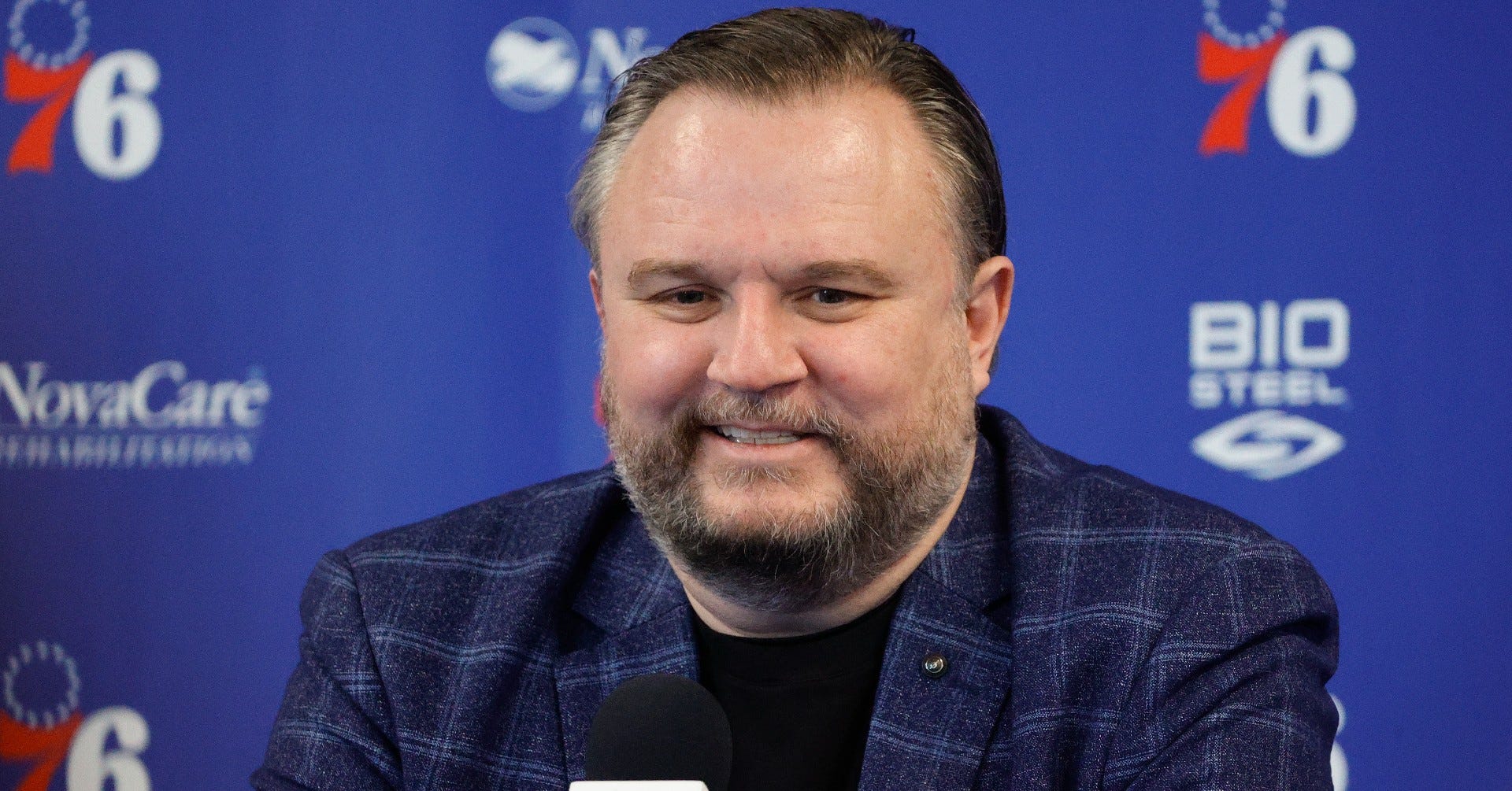
Daryl Morey getting fired immediately after the Celtics series has painted him as the clear scapegoat for the team’s issues, which is understandable. A lot of what’s gone wrong the past few years has Morey’s fingerprints all over it. The three-star roster construction philosophy. The constant cycling through niche role players. The obsession with theoretical optimization over functional playoff basketball.
But this wasn’t just a Morey problem.
Nick Nurse coached this team the way he always does: with a system heavily reliant on stars creating advantages in isolation while role players filled extremely narrow responsibilities around them. Ownership played its role too, consistently prioritizing star-driven marketability and financial flexibility over depth and team success.

As a unit, the front office, coaching staff, and ownership have actually had a remarkably unified front this year, which honestly might be their most shocking accomplishment given the lack of cohesion we’ve seen throughout the organization since the Sam Hinkie days. The problem is that everyone was aligned behind a philosophy that feels a lot closer to those Sam Hinkie days than where basketball actually is right now.
Modern playoff basketball is less about what you do well and more about what you do poorly that opponents can expose. If one player can’t shoot, teams ignore him. If one player can’t defend in space, he gets hunted every possession. If your offense depends entirely on difficult isolation shotmaking, playoff defenses eventually suffocate it.
The Sixers have often built the opposite, accumulating specialists instead of complete playoff players. On paper it could sometimes look like depth, but in reality it was usually just individual skills disconnected from one another. Jabari Walker can rebound but not defend. Dominick Barlow can defend but not shoot. Adem Bona can protect the rim (sometimes), but fouled constantly and seemed unable to catch the ball when it was passed to him. That’s all a bit of a simplification, but the truth is that the best teams in the league have more-well-rounded players with multiple skills that they can leverage to make a difference in short bursts, even against playoff-level competition.
The disconnect shows up even further in the players the Sixers have let go, who are actively contributing for the two best teams in the sport (seriously, watch this Thunder vs Spurs series if you haven’t been already, it’s incredible basketball). We lost Julian Champagnie in February of 2023 — who can both shoot AND rebound by the way, wonder who could have used help with the latter — for the sole purpose of seeing Mac McClung win the dunk contest in a Sixers uniform. We cut Isaiah Joe in October of 2022 to save a little extra guaranteed money. And then of course, there is Jared McCain.
While the value we got for McCain is the highest (some picks are better than nothing), he is still the cleanest example of the overlapping weaknesses between the front office, coaching staff and ownership. Everyone has seen the “We sold high” clips somehow still going around 3.5 months later, and I won’t deny that Morey dug himself a hole in that press conference. But this was on everyone.

Nurse didn’t want to play McCain because he didn’t fit into the star-focused, iso-ball offense and athletic, turnover-focused defense that Nurse prefers. Morey didn’t mind the roster loss because he wasn’t able to effectively quantify the importance of team dynamics and the personality/work ethic of McCain (even beyond the fact that he was still returning from a meniscus injury, as they themselves stated throughout the year). Ownership played a part too, because they wanted to duck the tax and save money in some way as opposed to truly prioritizing the depth and talent of the team. Three different branches of the organization, all arriving at the same flawed conclusion for different reasons.
Now I’m not going to sit on my high horse and say that these are franchise-altering decisions or that they would have changed the outcome of the Knicks series. When you get swept with an average scoring margin of over 22 points per game, you’re more than one or two minor roster moves on the margins away from truly contending. But the players the Sixers have lost are exactly the types of players modern playoff basketball keeps rewarding. Not because they’re stars. Because they play hard, move the ball, process quickly, embrace roles, and contribute to cohesive team basketball.

Grit, mindset and a willingness to put forth the requisite effort to win no matter what it takes are all outside of the stat sheet, and that’s a reason players like McCain, Champagnie, and Joe have all been able to contribute for other teams after being deprioritized by the Sixers. Each individual loss can be explained away. What’s concerning is how consistently the Sixers have kept making the same type of mistake. The margins matter now more than ever, even if they’re harder to quantify cleanly.
That’s why firing Morey alone probably won’t fix this on its own. Because unless the entire organizational philosophy evolves — from ownership, to the front office, to the coaching staff — the Sixers risk spending the next few years trying to perfect a version of basketball the rest of the NBA already left behind.
 | A guest post by
|
I agree with this by and large. But I do think you, and so many others, accidentally wind up arguing that in order for the team to be better, they need more good players.
Which is both true but also obvious.
When you list Sixers bench players who can only do one(ish) thing, and say “we should, instead, have players like X who can do two or more things” you’re really just saying “what if our bad players were, instead, better players?” Which, yes. But also…duh!
That said, I think the call out of the other portions of the organization aside from Morey is valuable and underdone in the wake of his firing.
I agree with all of your analysis about the kind of play that wins in the NBA in 2026. I agree that we've given up bench players who have the potential to fit into those kinds of teams. Hell, that's obvious when you see our ex-players in rotations that have played in the conference finals this year. I would just add one key detail you left out of your analysis. Ownership...front office management...coaching staff...ALL bought into building a roster around one SPECIFIC star player. Embiid. Joel's style of play, his preferences, his needs, his salary, have all dictated how our rosters have been constructed. It has always started with Embiid at the center of that Sixers solar system and then all the planets were selected to align with him and revolve around him.
All of this COULD have been fine, had Embiid ever been able to stay healthy for even a single regular season and playoff run. But the team has never been able to have the kind of continuity with Embiid that allowed the Sixers to play a couple months of its best basketball once the postseason began. It's like ownership, front office and coaching has never been able to have "proof of concept" with their strategy of building a winning team around Joel Embiid. He always has a health issue of one sort or another and can't play at 100% for long enough. It's conceivable that had Embiid ever put together a healthy 8-9 months in a row of NBA basketball that we'd have seen one of these rosters WORK. We'd have understood why the team felt it could move on from players like Shamet, Joe, Champagnie, Reed, McCain (etc) and kept the players they chose to keep. But that never happened, so we're left to blame the Sixers for moving on from clearly useful players while watching the team roster a bunch of one-dimensional bench pieces who are not capable of picking up the slack when the centerpiece of the team has more health issues.
It's now clear that nobody in team ownership or management had the boldness to put their foot down, at any point, and declare that the Embiid-focused roster needed to stop. Nobody was able to make that "sell high" case on Embiid and allow the team to pivot to a different approach - maybe one with a deeper roster of players capable of playing the kind of modern winning basketball that you explained in your essay. So, for that, I think they're culpable for not correctly "processing The Process" and helping the franchise avoid hitting this Embiid iceberg that is now clearly sinking our ship - as well as the career of Tyrese Maxey.
Good essay. Enjoyed reading it.