

If Only They Could Rebound
Beckett wonders — if (mostly) everything is going right for the Sixers, why aren’t they playing like it yet?

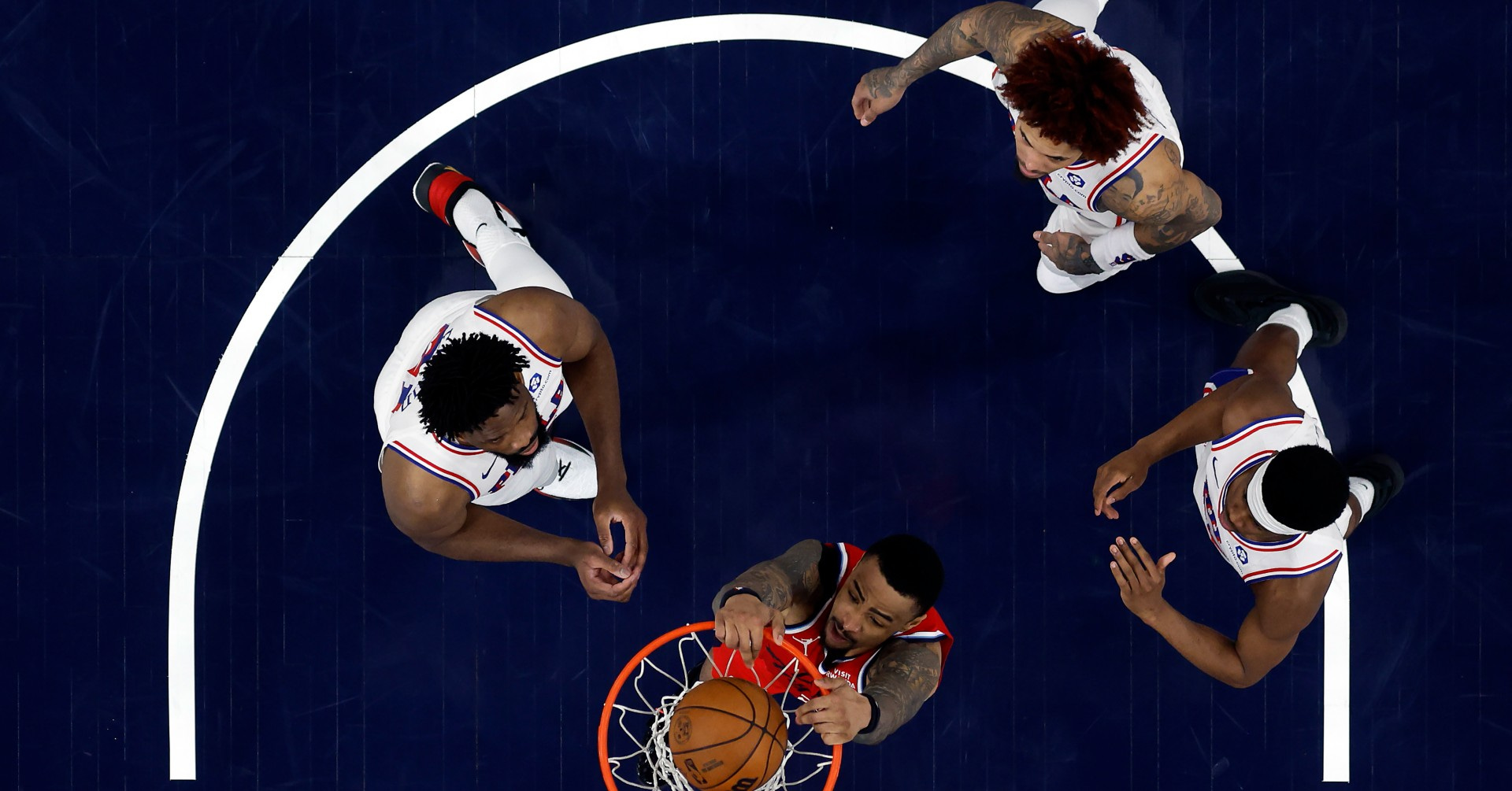
It feels like they should be better than this.
Almost everything this season for the Sixers has actually been… pretty good? Joel Embiid is playing consistently again and hitting an offensive stride many (myself included) thought we’d never see again. Tyrese Maxey somehow took another leap. VJ Edgecombe is the prince who was promised, both on the court and in the vibes department. Daryl Supreme nailed both two-way signings to fill out the frontcourt depth with Dominick Barlow and Jabari Walker.
Of course, this also made something like the Paul George suspension feel inevitable. As AU so effectively portrayed, you can’t only have good vibes in Sixers land after all. But even accounting for that, the sum of all these wonderful parts ends up feeling like a pretty unsatisfying whole. The Sixers are still a middling team, hovering right on the edge of the play-in. Capable of stringing together wins, sure, but seemingly always fighting uphill to do it.
So why does a team getting so many things right still feel like it’s living possession to possession? There’s no clean, all-encompassing answer, but every explanation eventually touches on the same problem: The Sixers aren’t closing out stops on the defensive glass.

The numbers are blunt. The Sixers rank second-to-last in the NBA in DREB% — how often they actually secure an opponent’s missed shot. When they don’t, it hurts: Those possessions are bleeding 1.16 points per second chance, the ninth-worst mark in the league, and equivalent to handing opponents a 116 offensive rating after every offensive rebound.
NBA tracking data (which has gotten absurdly granular by the way) might provide some background to how this happens, as the Sixers also record the fewest box-outs per game on defensive rebounds. In other words, the team is often watching the ball float through the air and assuming it will fall into their lap. Oh, the other team shot? Well, it must be our turn next! I’ll just stand here and wait.
Now, you don’t need to be a team of Mr. Fundamentals on the glass to rebound well. The Houston Rockets — sixth in the NBA in DREB% and a team that feels synonymous with physicality — actually rank second-to-last in box-outs themselves. The difference isn’t just in technique. It’s also activity.
You can see it immediately on film. In one clip, Sixers players watch the ball descend while Nique Clifford casually grabs it in the middle of three defenders. In another, Houston’s entire lineup is moving toward the ball as Alperen Sengun works to make sure Isaiah Jackson never even gets a look at the rebound. Same sport, wildly different urgency.
Obviously, personnel plays a role here too.
It starts with the guards. Guard rebounding hasn’t been up to standard, and part of that is by design. The fast-paced, transition-heavy style that unlocks Maxey and Edgecombe’s open-floor magic also leaves fewer bodies committed to finishing possessions. The data reflects that tradeoff: VJ Edgecombe and Kelly Oubre Jr. carry the two most negative on/off differentials in offensive rebounding rate allowed, with Maxey not far behind in fourth. Bona sits third (more on him shortly), and there’s a noticeable drop-off after those four.

That overlap isn’t random. Maxey, VJ, and Kelly are three of the team’s most aggressive transition pushers. When all three share the floor together — over 500 minutes so far — the Sixers allow opponents to recover a staggering 37% of their missed shots, nearly seven percentage points worse than when that trio isn’t on the court.
When guards are tasked with offense-first responsibilities, someone has to pay the rebounding tax.
Then there’s the big rotation. Andre Drummond could theoretically be a knight in shining armor — or a 76er in a Blue Coat, I guess — but his role has nearly vanished. With the team prioritizing Bona’s development, Drummond has received 11 DNPs in the last 16 games where both Joel and Bona were available, and has logged under four total minutes across the last nine.
For all of Mike’s (fair!) frustration with Drummond’s lack of contested rebounds last year, the results are undeniable. He leads the team in fgDR%, securing 26% of all available defensive rebounds while on the floor, good for the 96th percentile among bigs and sixth best in the entire league. Compare that to Bona’s rough 12% (11th percentile) — it’s much harder to defensive rebound effectively when you’re chasing blocks as often as Bona is — and it’s easy to see how a modest shift in minutes could change the math.
Embiid, often the target of fans’ ire on the defensive glass, has actually been just fine here this year, with a solid but unspectacular 16% fgDR% (42nd percentile among bigs), and the team rebounds at the exact same level with him on and off the floor. However, that’s not to say he is blameless in this rebounding epidemic, as this middling defensive rebounding rate is the worst of his career by far. Embiid had previously excelled here, ranking above the 88th percentile on the defensive glass for seven straight seasons, before starting to fall off last year with his injuries.

Dominick Barlow has been another part of the equation. His effort on the offensive glass is undeniable — he grabbed TEN offensive boards last night against the Clippers — but that hasn’t translated defensively. He’s ending possessions at just over an 11% fgDR%, placing him in the 8th percentile among bigs.
None of this means the Sixers need to become an elite rebounding team overnight. They don’t need to turn into the 2004 Pistons. They just need this to stop being such a liability.
That’s where the trade deadline inevitably enters the conversation. If there’s a move to be made, getting help on the glass — especially from the wing, with Paul George newly sidelined — could quietly raise the team’s floor. Someone like Pat Connaughton, who has fallen out of the rotation in Charlotte but has been an excellent defensive rebounding wing for most of his career and can space the floor offensively, could help without breaking anything else. Naji Marshall fits a similar mold, though he likely costs too much. Cheaper options like Dalen Terry or Devin Carter offer rebounding plus playmaking utility. All of this does feel fairly unlikely from a contract standpoint given the looming tax duck — and knowing the Sixers, we’d likely spring another leak depending on which rotation piece we trade away in the process — but a man can dream.
Still, the path is clear. The Sixers are already doing enough good things to matter, and they have shown themselves capable of the effort needed on the glass through their surprising offensive rebounding success. Turn it around, and maybe the good vibes of this season can turn into consistent success, or who knows, maybe even beating a good team in the playoffs.
 | A guest post by
|
I know this is sadly moot now, and has nothing to do with rebounding, but I noticed a weird Sixers stat recently. Lineups with Maxey and McCain this year are very good on defense (83rd percentile per CtG which, I believe excludes garbage time). And, last year, they were above average (63rd percentile).
The next thing anyone seeing that will say is “Sample size!” And I would have thought the same thing. But combined it’s like 1200 possessions (our roughly 12 full NBA games worth). Sure, that isn’t huge but considering it doesn’t have garbage time that’s 1/6th of an entire season of possessions…not nothing.
Love the deep dive here! The disconnect betwen what's working individually and the overall results is suprisingly common in basketball. I've seen this exact pattern with a few teams where guard aggression in transition becomes a hidden tax on the defensive glass. The Drummond/Bona minutes thing is tricky tho because development value vs immediate rebounding help.