

Would the Real Jared McCain Please Stand Up?
As McCain shuttles to and from the G-League, Beckett explores what’s changed from his dominant rookie stretch to now.

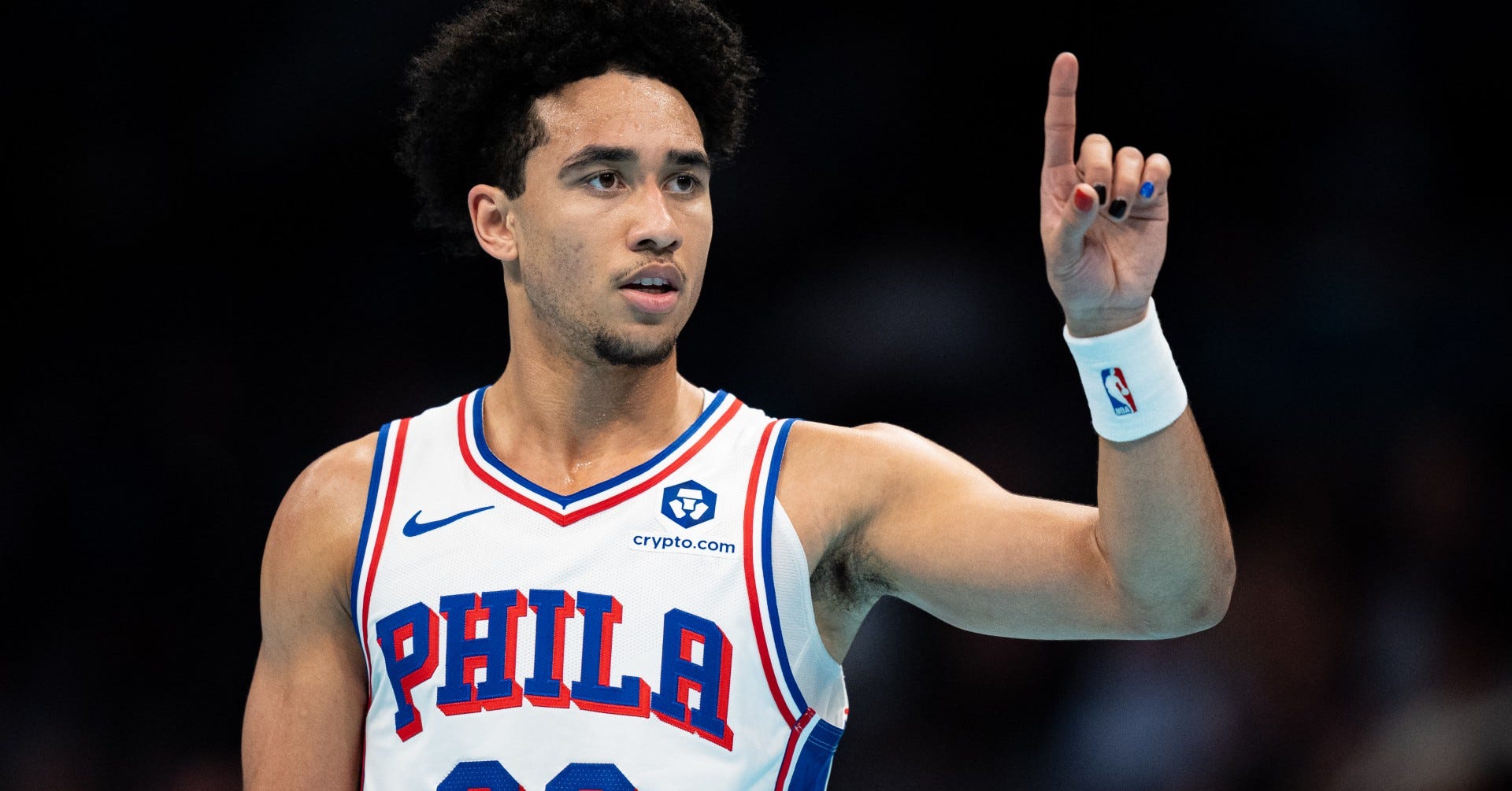
Jared McCain’s recent assignment to the Delaware Blue Coats (a much better name than the 87ers for the record) feels like a moment of reckoning — especially for those, like Spike, who see McCain as a core piece of this team going forward. On the surface, it reads like a demotion. However, I’d prefer to view it as a useful checkpoint for understanding what has actually changed in his game.
The timing is helpful, as McCain has played 522 minutes so far this season — almost identical to the 504-minute takeover stretch he had last year from November 8 through December 4, and not far off his total workload as a rookie (594 minutes). That symmetry gives us a clean comparison point. At this point, it’s clearly not just an extended cold streak. It feels like something is fundamentally off, and the data provides a fair way to test that instinct.
Let’s start with what jumps off the page: the shooting has been bad.
His eFG% (weighted 2’s and 3’s) has gone from 56% last year — good for 79th percentile among combo guards — to just 44%, which is a brutal 2nd percentile. In particular, his 2-pt efficiency has been abysmal, making under 38% inside the arc. For reference, he shot better than that from three last season! While volatility is normal for young guards, this magnitude of difference has been alarming. Whether the cause of this is rhythm, lingering effects from injury, Nick Nurse rotations, or a combination of factors is hard to pin down, but the efficiency has seen a major hit.

He’s also not getting to the line. McCain is being fouled on his shots roughly half as often as he was last year, which compounds the efficiency drop and removes one of the easier ways for a scorer to stabilize production when the jumper isn’t falling.
To be clear, the signal isn’t all negative. The Sixers have been +2.9 points per 100 possessions better with McCain on the floor this season. That’s real value. There are plenty of possible reasons for that signal: the threat of his three alone could provide spacing, his willingness to keep the offense flowing could get better looks for teammates, or it could even be just a misleading small sample size. But when you compare it to last year’s +4.6 mark, it becomes easier to understand why concern has crept in. Even if he is still helping, he’s not bending games the way he briefly did before.
However, those are all fairly obvious points you can pick up just by watching with your own eyes. So what’s changed beneath the surface? The biggest difference is usage.
McCain’s breakout stretch last season coincided perfectly with Tyrese Maxey missing six games and Joel Embiid appearing in only four of those 13 contests. With the offense suddenly stripped down, McCain’s role expanded overnight. His usage spiked early and never really came back down, even after Maxey returned. During that stretch, he posted a 26% usage rate (77th percentile), while this season, that number sits at just 17 % (18th percentile). A shift in game responsibility of that magnitude is sure to have an impact on a player’s approach.
That context matters, but it doesn’t tell the full story. The real separator is how McCain performs with Maxey on versus off the floor.
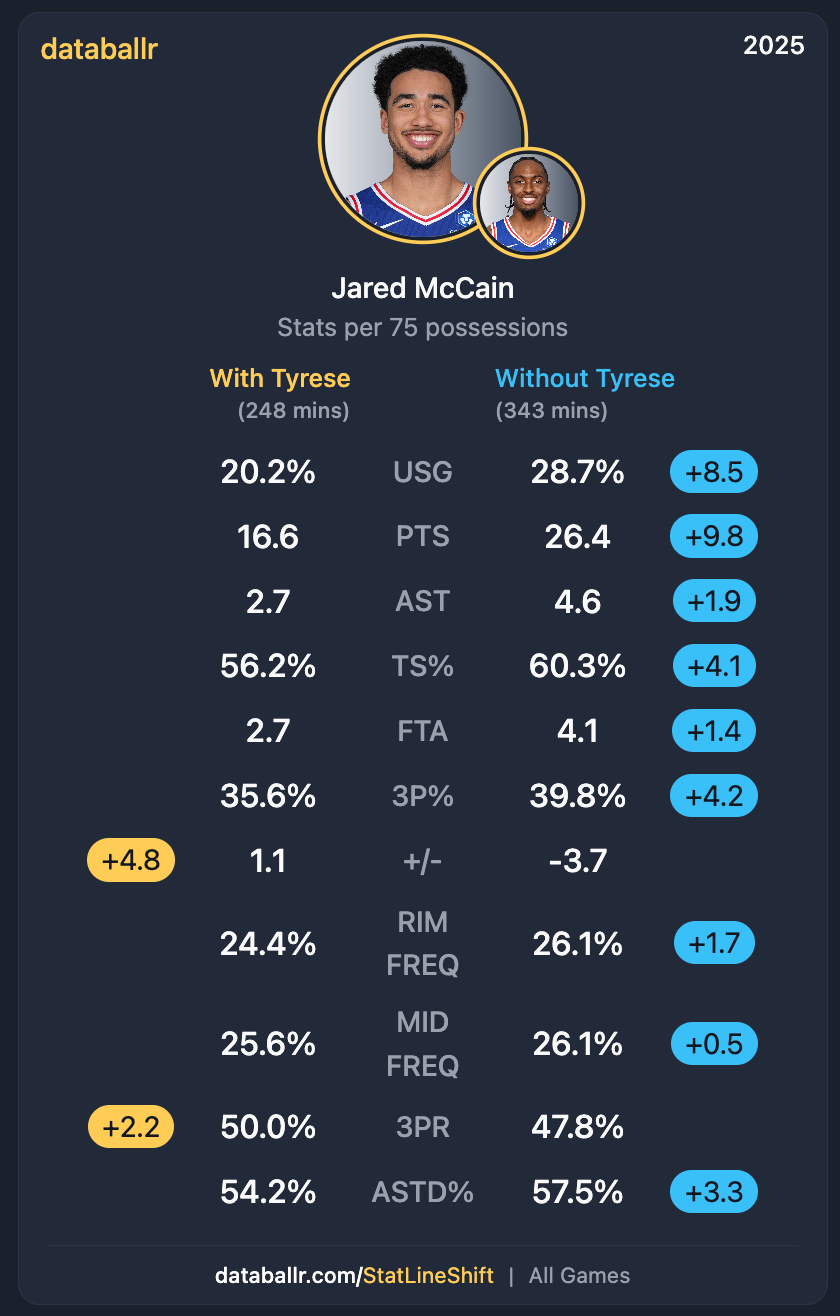
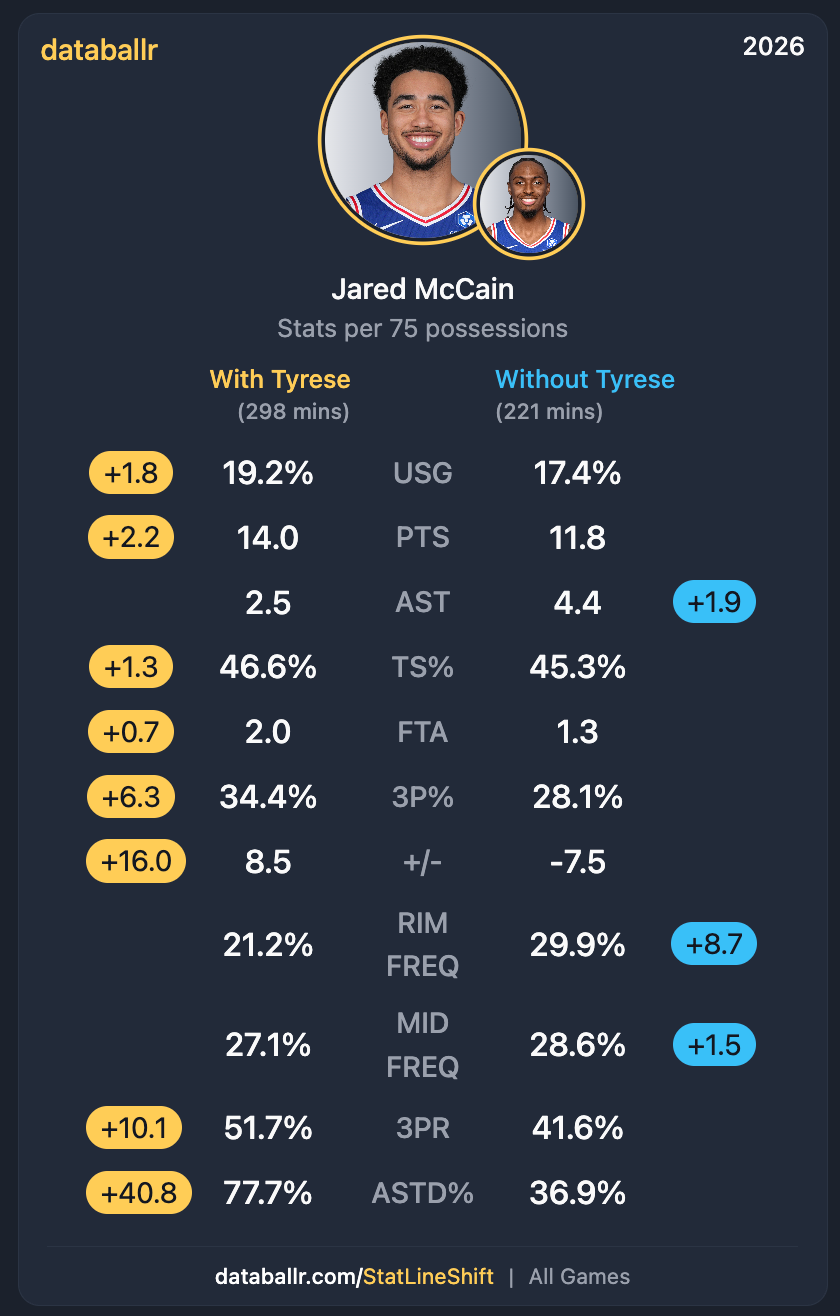
Jared McCain’s performance in key areas with and without Tyrese Maxey in the 2024-25 season (left) and the 2025-26 season (right).
When you compare his per-75-possession numbers across seasons, one thing becomes clear quickly: McCain alongside Maxey looks largely the same as it did last year. His on-ball usage is similar. His playmaking is similar. His free-throw rate hasn’t meaningfully changed. He’s taking a few more midrange shots — something that stands out on film — but not enough to fundamentally reshape his profile. The efficiency drop is significant, with his true shooting percentage down nearly 10 points, but that decline shows up everywhere and lines up with the “obvious stuff” we already covered.
The real shift happens when Maxey sits.

Last season, those minutes belonged to McCain. The usage, scoring, playmaking, and free throw volume all exploded, and somehow, his efficiency followed. Those 343 minutes were the high-end Jared McCain experience — the version that pops in your head from a YouTube highlight reel set to the tune of “Enter Sandman” (no, there’s no reason I chose that song in particular, why do you ask?).
This year, that version hasn’t shown up in the same way. His playmaking still ticks up without Maxey, but nearly everything else takes a step back. He’s not commanding possessions, drawing fouls, or tilting the floor from beyond the arc like he did during that stretch. In these runs, McCain is asked to function as the primary organizer rather than a high-usage scorer, and without the same freedom to dominate possessions in the way that fueled last year’s run, he’s been unable to find his balance.

There are plenty of reasons this could be happening. Embiid and Paul George are available more often, and VJ Edgecombe has emerged out of thin air as someone who needs touches. McCain missed training camp and is still working back from injury. Or he’s a small guard, and the league has figured out how best to capitalize. All of these could be clear and logical explanations for a dip in production, though they also highlight how different his role (and margin for error) has become on a healthier, deeper Sixers squad.
So what does it all mean? I’m not here to take a principled stand on whether Jared McCain is a future star (though I do believe there is an impactful NBA player hidden away somewhere in his 6’3” frame). Belief in him ultimately comes down to how you interpret those 343 minutes from last season. Were they a glimpse of hidden upside, temporarily unlocked by circumstance but very real? Or were they a rookie-year Linsanity run that only works in short bursts on a stripped-down roster?
What is clear is that the combination of that hot stretch and the Sixers being surprisingly competitive this season has accelerated expectations. McCain hasn’t met them yet, but that doesn’t mean they were misguided in the first place. He’s played just over 1,000 minutes in his NBA career and just 54 games in non-garbage time; it’s still incredible early in his career to be making a concrete judgment about what he can or can’t be. So, this Blue Coats stint isn’t necessarily a verdict. It’s a pause — and maybe a needed reset for both us as fans and McCain as a player — before we find out which version of Jared McCain is closer to the truth. Only time will tell.
 | A guest post by
|