

Can They Do It Again?
Beckett breaks down how the Sixers might be able to overcome the inevitable Celtics three-point barrage and maybe, just maybe, pull off a miracle...

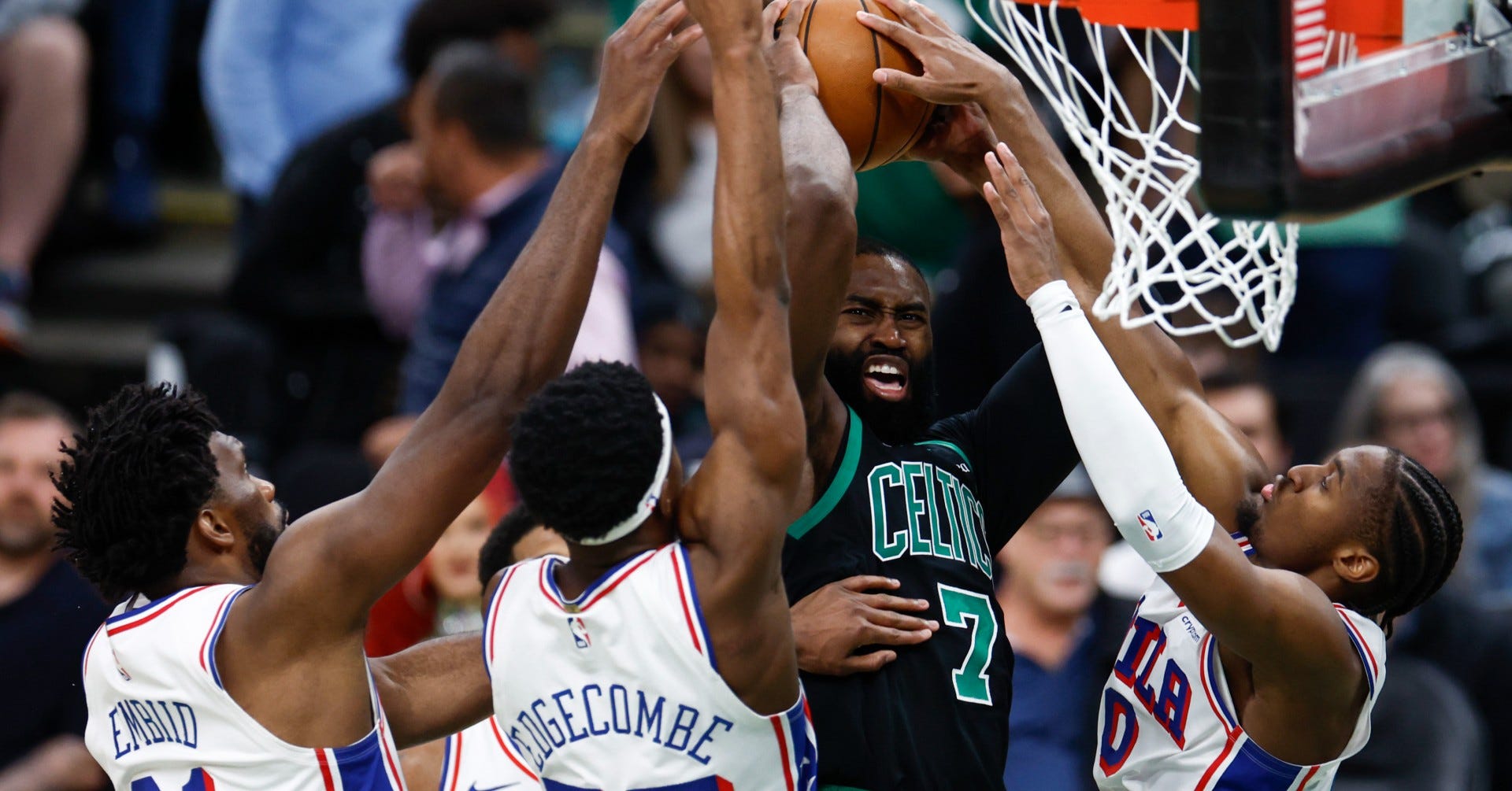
The Sixers exist to push us into the depths of despair… so it was only right that they put together one of their best games of the season when down 3-1 to ignite the sparks of hope once again. Most prognosticators (myself included) didn’t think going in that this series would go past five games, but now they’re just two wins away from pulling off the greatest series victory of the Process Era — and somehow, against all better judgment, it feels at least a little more real after last night. That’s how they get you.
We know the obvious reason for the wins and losses: the Celtics live and die by the three, and so far they have died twice and lived thrice (26.9% from three in losses this series and 41.7% in wins), and in many ways, it really is that simple. The problem is the Sixers can only do so much about that — three-point shooting can be notoriously fickle regardless of defensive effort — and the Celtics are an elite shooting team overall, so the Sixers likely have to win at least one game where Boston gets hot again from deep. Relying purely on Celtics shooting variance is less a strategy and more a prayer.
So where else have they been able to make up the difference, and how can they leverage it into another win in Game 6?

Defensive rebounds are one clear area, as expected coming into the series, though the reason may not be quite what you think. Of course, the rebounding overall has been brutal, as the Sixers have allowed the Celtics to grab over 40% of their misses (10th percentile) in Games 2-4, and the Sixers have only been above average on the defensive glass in their Game 5 win on Tuesday. Now you might be saying to yourself: “Well the Sixers won Game 2, so how did they pull that off while still giving up a boatload of second chances?” The key (outside of the aforementioned three-point shooting) is what they allow Boston to do with those second chances.
In the Sixers’ three losses, the Celtics absolutely shredded them on putbacks, scoring after offensive rebounds at rates of 1.25 points per possession (PPP) in Game 1, 1.40 PPP in Game 3, and 1.20 PPP in Game 4, all well above average. This is why every bucket off of an offensive rebound feels like an absolute dagger — because, statistically speaking, it basically has been. However, in their two wins, the Sixers have been able to hold the Celtics’ putback scoring to just 0.83 PPP in Game 2 and 0.56 PPP in Game 5, both excellent numbers.
As much as I would love to say otherwise, it’s probably too much to ask at this point for the Sixers to become a good defensive rebounding team in general. We’re too far into a season of lackluster effort ending possessions, and Boston is a brutal matchup on the glass. But if the Sixers can sharpen their focus after the offensive rebounds they will inevitably allow — staying attached to shooters, avoiding scramble breakdowns, and limiting the actual damage of those second chances — then they might have a real shot. They do not need perfection here. They just need the rebounds they lose to stop instantly becoming backbreaking.
This commitment to hanging back and cleaning up possessions could cost them some transition opportunities, but honestly, that may be a tradeoff worth making, because the other notable win condition for the Sixers is leaning harder into their halfcourt offense.

The Sixers’ offensive execution in their two wins has been excellent, and it has relied almost exclusively on 95th percentile scoring in the halfcourt. In fact, in those wins, Philadelphia has simply been more efficient in the halfcourt than in transition, which feels surprising at first until you remember just how good Boston is at limiting both the volume and efficiency of open-floor chances — something Sixers’ fans will be all too familiar with from the seemingly dozens of times Derrick White or Jordan Walsh have broken up clean-looking transition opportunities.
When the Sixers can slow the game down and execute, it allows them to set their defense more effectively, which reduces transition cross-matches, which then also helps limit offensive rebound chaos. One clean possession can prevent three future problems, which for this team is about as close to stability as it gets. It all links together. Isn’t basketball so fun?

This is still a deeply dangerous game to play as a Sixers fan. Hope has historically been the first step toward emotional ruin. No, the Sixers aren’t suddenly favorites. Yes, Boston’s shooting could still erase all of this in one avalanche quarter. But this series has shifted from “please don’t embarrass yourselves” to “wait… is there actually a chance?” If the Sixers can keep controlling what is in their power — halfcourt precision, defensive discipline after misses, and enough mental resilience to survive the inevitable Celtics shooting barrage — then maybe this dream isn’t dead just yet. And honestly, what’s the Process Era without one more completely unnecessary emotional investment?
 | A guest post by
|
I really like this article Beckett. Well done. You’re hitting the important points. They did what you said and won game 6. How we gonna do game 7 in the garden?
Nicely written. Well done. Going into Thursday's game 6 and feeling that the Sixers chances to win this series are still dubious is not a matter of being a "hater" or not. It's simply looking at the Sixers season-long struggles and feeling skeptical they can put together 2-4 more halves of the kind of above-their-heads basketball which they managed to display in the second half on Tuesday. That second half put on display the sort of basketball this roster might have been able to make their style of ball this season, but ultimately couldn't. We've been lamenting this same kind of thing for years. Sixers have rosters that look pretty good on paper but can't stay healthy or together long enough to ever show it consistently - certainly not at playoff time. I think your essay did a nice job of explaining how Tuesday's second half was an anomaly for this Sixers squad. Our excitement over seeing it can get one a bit out over their skis when it comes to expectations for the next game (and maybe two). As I think about it now, that second half on Tuesday felt like a "proof of concept" on this year's roster. Personally, I never thought it was a GOOD concept, but for one half of basketball, against a very good team, in a critical playoff elimination game, it was a roster/rotation that worked.