

On the “Seventh-Most–Important” Man From Boston
Beckett dives into the analytics on Jaylen Brown and explains why it’s important to separate “overrated” from “bad”.

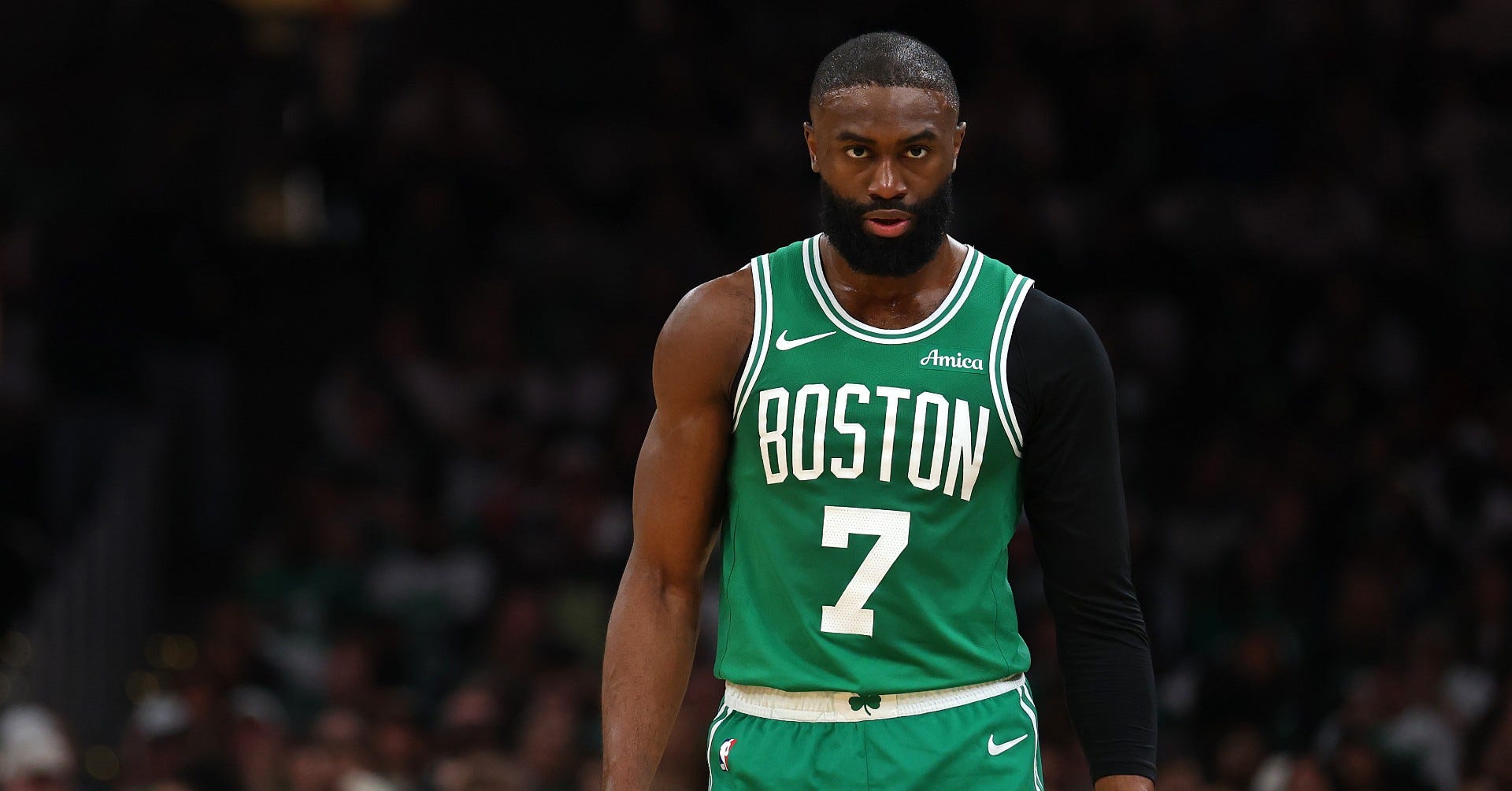
Thank goodness we’re all having a sane and rational conversation about Jaylen Brown and analytics…
As has been rehashed a bajillion times in the last few weeks, the Sixers have set the NBA world ablaze with their stunning trade of Paul George and several draft picks for Jaylen Brown. However, that firestorm has reached a boiling point with several reports about analytics coming out that claim Brown was the seventh-most-important player on the Celtics or that he isn’t a top-50 player in the NBA.
Let’s start with the obvious: those statements are ridiculous and a clear case of someone using numbers without any level of context whatsoever — a.k.a. someone being bad at analytics. Understanding the context around data is what an analytical professional is supposed to do. It would be very easy for me to create a model that spits out Brown as the seventh-most-important player on the Celtics, but if I saw that as the model output, I would question the model’s overall capabilities to rank players, instead of Jaylen Brown’s capabilities to play basketball. There are plenty of people bad at their job who get a platform, and we simply do not have to listen to them (for instance, Stephen A. Smith on NBA Draft night).
There are obviously numbers that show up worse for Brown than for other players, and we will get into those shortly, but the important theme to remember when analyzing these numbers is that they are comparing him to other star talents. There are extremely few players in the world capable of even attempting to carry the usage load that Brown has shown capable of carrying — only Luka Doncic (36.8%) and Giannis Antetokounmpo (35.8%) had a higher usage rate than Brown (35.1%) last season — let alone doing so as the only star player on a 56-win team that earned the second seed in the East. And therefore that’s the benchmark he is compared to as a player. You can’t look at Baylor Scheierman or Neemias Queta and claim they’re more important to the Celtics than Brown just because they were spoon-fed easy assisted looks through the Joe Mazzulla system and capitalized with high efficiency on the limited volume of shots they had to take. It’s nonsensical.

Now that that’s out of the way, we can get to the point of the analytics themselves and see how he compares to those other top 20ish players in the league. Once again, for the media personalities in the back, nothing you see here is to say he’s not a top 20 player in the league at minimum. It’s simply attempting to differentiate at the finest margins among the best of the best.
Brown’s greatest strengths are as a volume scorer, where he put up 28.7 PPG last season (fourth in the NBA). He was the outlet for the Celtics when someone had to go get a bucket, and he took a noticeable jump in both volume and efficiency with Jayson Tatum out for most of the year due to injury. However, while he put up a ton of points, the efficiency was just average, as Brown had a 57.4% TS% (literally 50th percentile for a wing in the NBA) on that volume. When compared to the best of the best — like Shai Gilgeous-Alexander (67.0% TS%), Stephen Curry (64.8%), Kawhi Leonard (63.3%), Doncic (61.8%), Anthony Edwards (61.7%), and even Donovan Mitchell (61.7%) — it’s easy to see that Brown’s just a touch behind.
In addition, at the highest level, your impact as a player is not just about how many points you score and how efficiently, but also how well you keep the offense functioning overall. Brown is a strong scorer for himself — but the team numbers are where the analytics start to come into play more noticeably.
The primary issue is his struggles with ball security. Brown ranks in the 1st percentile among small forwards in the NBA in scoring turnover percentage (10.3% sTOV%), which measures the volume of turnovers committed while attempting to score (non-passing turnovers). Even beyond just small forwards, the numbers are nearly twice as bad as those of other offensive engines like Jalen Brunson (4.1% sTOV%), SGA (4.4%), Doncic (5.0%), and our own Tyrese Maxey (5.0%), and represent Brown’s difficulty with keeping the ball under control. This is a clear gap in his perception as an offensive engine — even worse than struggling to get teammates involved in a possession offensively is losing the possession altogether.

But Brown’s most widely discussed analytical numbers over the last few weeks have been his on/off splits. Over the last four seasons, the Celtics have had a worse net efficiency with Brown on the floor than on the bench. A lot of this was previously explained away by the fact that he was staggering minutes with Jayson Tatum, but this year without Tatum available — where Brown once again had a negative on/off (-5.5 points per 100 possessions) — has thrown a wrench into that argument. How on earth could the numbers frame him as a consistently negative player as a Finals MVP and near First-Team All-NBA selection?
As with all analytics, the most critical step in evaluating numbers is to understand the context from which they are coming. In Brown’s case, some of the explanation can likely come from the just fine scoring efficiency and subpar turnover suppression mentioned above, but his context is also unique and could explain a lot of the lack of impact.
Mazzulla has put together a terrific environment for team success, especially for role players, with quick drive-and-kick actions, tons of catch-and-shoot threes, and assisted rim attempts. Brown’s strengths are the exact opposite of the quick decision-making, ball movement, and extremely high volume from three that make a player elite within that system. Remove Brown from that equation, and you can make up for a drop-off in talent through an increase in scheme fit. In addition, Brown is typically matched up against the opposing team’s starters. The bench unit for the Celtics gets to come in and destroy opponents’ benches, an area where Boston has had a clear advantage for years.

Are a few of these numbers a bit concerning? Sure! Does any of this mean that you can’t win with Jaylen Brown on your team? No, obviously not! The moral of the story here is that analytics are great to find the areas that you may need to work around with a player to help them find success, but this is clearly a player you can work around because the Celtics won a championship with Brown as a top-two player and Finals MVP. He might be a little overpaid for what he offers as a player, but it doesn’t matter at the end of the day if you win. So often in these nuanced discussions, people are initially talking about whether a player is overrated or underrated, and it turns into a discussion of whether that player is good or bad. We’ve reached that point in the Jaylen Brown analytics discussion, and it’s exhausting.
The good news for everyone is that the Sixers are a great environment to find out the truth of the matter. Nick Nurse’s system of Just-Iso-And-Go-Get-A-Bucket Ball is about as far from Mazzulla’s quick ball movement reliance as you can get. The weakness of Brown’s playmaking, while real, will have less of an impact here on everyone else. In addition, Brown will get the opportunity to play with a (theoretically) lower offensive load next to Maxey, Joel Embiid, and VJ Edgecombe. When he’s not forced to create everything on his own, he might be able to find more efficiency and have the energy to put more effort into the little things that make a star player truly elite.
But still, bottom line: Either the on/off analytics ghosts follow him down I-95 or they don’t. We’re finally going to find out.
 | A guest post by
|