

It’s Gonna Take More Than That
Beckett breaks down the key trends of last night’s game and why the Sixers need to make more adjustments than simply praying for shooting luck.

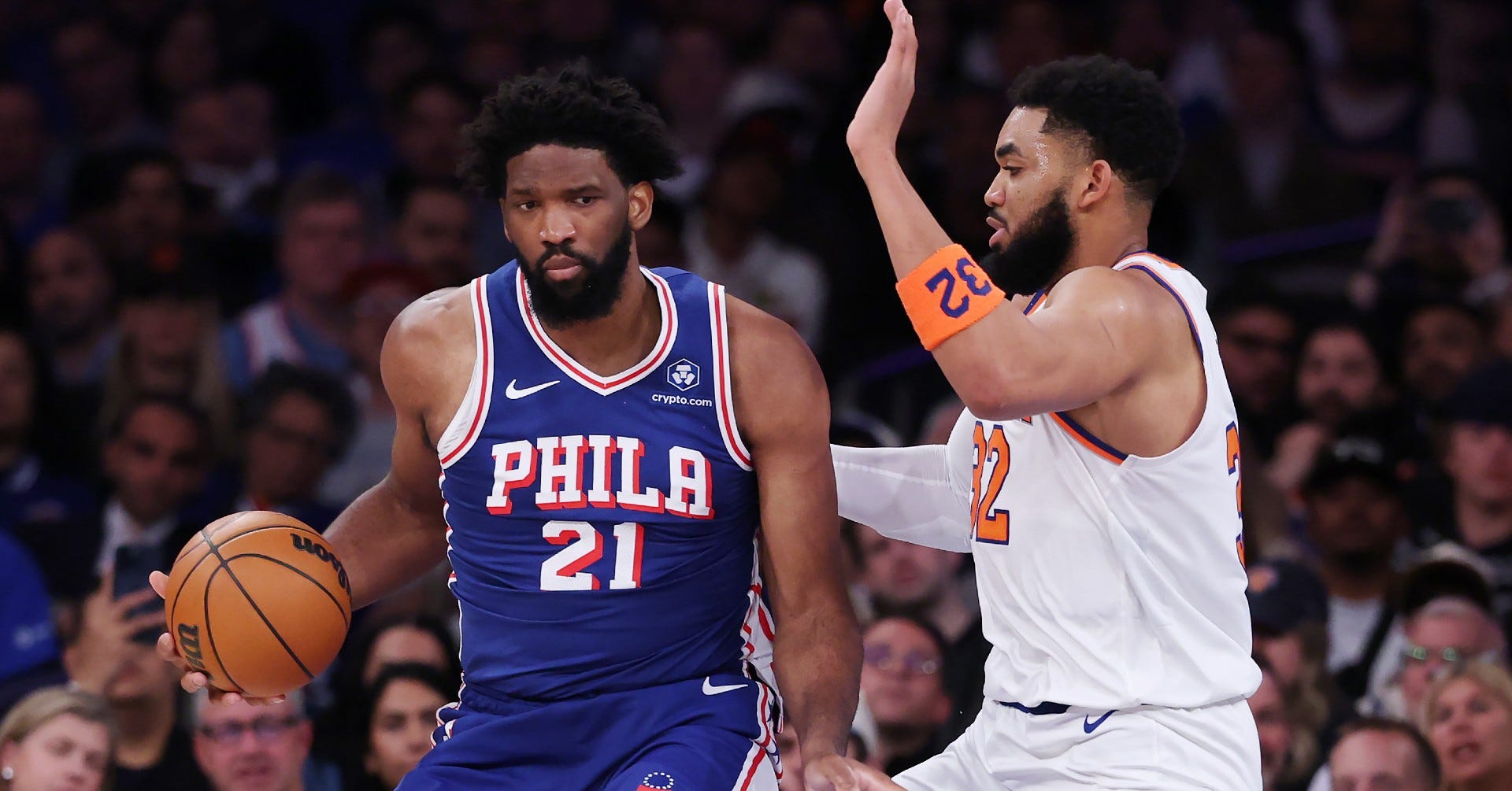
Let’s not do that one again, please.
The Sixers walked into Madison Square Garden last night with the swagger of a team coming off their best playoff win in the last two decades and were promptly punched in the mouth. They looked like they were playing a regular-season game and seemed surprised when the Knicks were not.
Let’s be clear: the Sixers were at a severe rest disadvantage for this one, coming off a grueling, down-to-the-wire Game 7 on Saturday, while the Knicks last played on Thursday in a game where their starters were done at halftime (they were up 72-22 in the second quarter!). That could end up explaining a lot of the malaise the Sixers appeared to be under throughout the night. However, I didn’t like what I saw from a game plan and execution standpoint either, which makes this more concerning than a simple scheduled loss.
Offensively, the approach left a lot on the table, most notably in failing to consistently target New York’s weakest defender: Jalen Brunson.

The Sixers showed extremely limited interest in going at Brunson, especially in the first half, which allowed him to hide in the corner on defense and then absolutely torch whoever was guarding him on the other end. According to NBA tracking data (Figure 1), Brunson spent most of his time defending Kelly Oubre Jr. and Quentin Grimes, and was rarely forced to switch onto the Sixers’ big three of Joel Embiid, Tyrese Maxey and Paul George. The few times the Sixers did attack him, they were successful — posting a 62% effective field goal percentage — but they didn’t do it nearly enough to drive real offensive success.
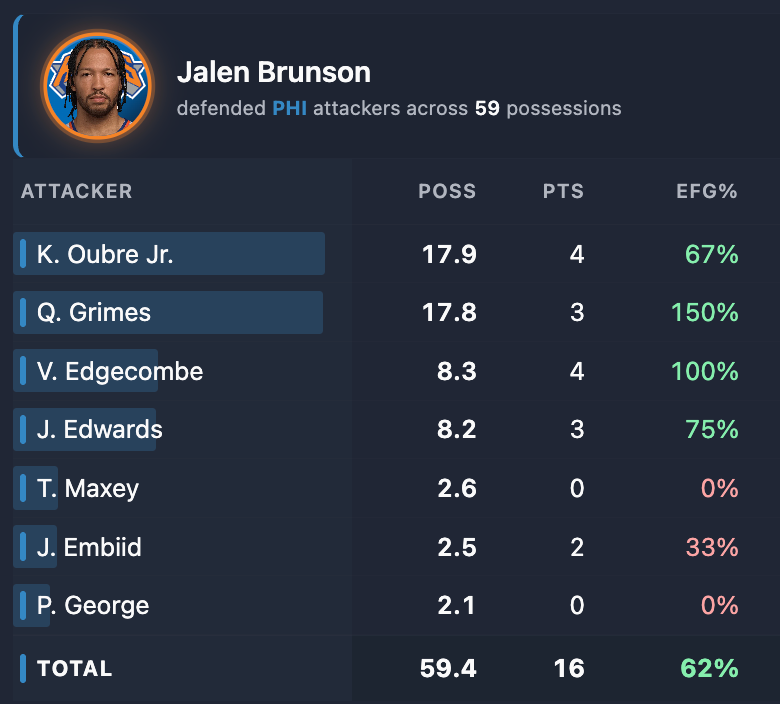
Figure 1: Jalen Brunson was able to avoid tough matchups on defense for most of the night and save his energy for offense instead. Source: databallr.
This happened in part because of a heavy reliance on Embiid-focused offense. That works against a team like Boston, where the weakest defenders are their bigs. That is not the case against New York, where the pressure point is Brunson — and to a lesser extent, Karl-Anthony Towns if you can force him to move laterally. They need to get their guards more involved and force Brunson into actions at every possible opportunity.
The other major offensive issue was turnovers, both volume and type. The Sixers posted a higher turnover rate than in any of their games against Boston in the last series, outside of the disastrous Game 1 blowout. More importantly, many were live-ball turnovers that directly fueled New York’s transition attack, where they scored an absurd 1.60 points per possession off steals.
What’s frustrating is that this hasn’t been a constant problem against New York. The Sixers were much better at taking care of the ball in their first three matchups, all of which were wins or competitive games. But they’ve struggled badly in the last two — both blowouts. Turnovers are shaping up to be a massive swing factor in this series. The Sixers have the personnel to clean it up — Maxey’s four turnovers in limited minutes were particularly uncharacteristic — but they simply cannot afford more games like this from a ball security standpoint.
Defensively, the issues were a bit more nuanced, but just as damaging.
They lacked the same attentiveness that defined the final stretch of the Celtics series. I won’t say effort wasn’t there — they played hard, especially early — but it often crossed into playing out of control. And when you’re out of control defensively, effort quickly turns into mistakes. The Sixers gave up easy looks by losing back cutters, getting caught flat-footed on closeouts, and then overpursuing closeouts to leave drivers wide open.
Now up to this point, the case has leaned toward this being more schematic than fluky — a real disadvantage, even if it’s one that the coaching staff can adjust for. But there were also some clear outlier elements, particularly in New York’s shooting.
Before garbage time, the Knicks shot 58.3% from three and 73.3% on midrange attempts, both in the 100th percentile for any NBA game this season. The Sixers were bad, but they weren’t THAT bad. If you’re looking for reasons to believe this game won’t repeat itself, this is the strongest one by a long shot.

Be that as it may, I wouldn’t rely on shooting regression entirely. Part of the concern is that the Knicks still generated clean looks. They won’t shoot like this again — if they do, this series will be over quickly and the Knicks are rolling to the title — but the Sixers gave up too many open shots for comfort. The other part is that not all of New York’s success is subject to shooting variance. At the rim, the Knicks shot 73.9% compared to just 58.8% for the Sixers on similar volume. That gap is about physicality, positioning and offensive approach, not just luck.
There’s also a larger trend worth noting: the Knicks appear to be figuring out the Sixers’ defense more with each matchup. Their offensive efficiency has increased in every game against Philadelphia this season (Figure 2), culminating in the blowout performances we’ve now seen.

Figure 2: The New York Knicks have gotten more efficient on offense in each game this year against the Philadelphia 76ers, leading to their recent blowout victories. Source: Cleaning the Glass.
A big part of that may come down to Karl-Anthony Towns pulling Embiid and the Sixers’ rim protection away from the basket. When Embiid is forced to defend in space, the entire structure behind him starts to crack. The Sixers need to either adjust how they’re handling that matchup defensively — like hiding Embiid on Josh Hart and praying he doesn’t shoot 45% from three again — or punish it more consistently on the other end when KAT is at the five.
This inability to get stops had a cascading effect as well. The Sixers were constantly taking the ball out of the net, which killed any chance at building a transition offense — one of the clearest weaknesses for the Knicks, who rank 25th in transition defense. You can’t exploit a weakness if you never get the opportunity to run.

All that said, I’m not going to say they can’t turn this around. If these issues were obvious from the outside, they were certainly obvious to a coaching staff paid to diagnose them. And while some elements of the Knicks’ shooting could sustain, this level of efficiency is not. There are also the classic playoff truisms: the series doesn’t start until the road team wins, and each game counts the same regardless of margin. We’re one round removed from Boston winning multiple games by 30+, including the series opener, and the Sixers winning the series anyway. Swings happen.
However, a repeat of this approach — both schematically and in terms of execution — is not tenable if the Sixers want to make this series competitive. We’ll have plenty of time in the offseason to cherish our first-ever victory over a good playoff team in the Process Era. But the Sixers need to move past it and make real adjustments now if they want a chance at another one.
 | A guest post by
|