

Evaluating Joel Embiid's Start to the 2025-26 Season
MOC on how we should be feeling about the Big Man's play so far this year, both compared to last year and compared to everything else.

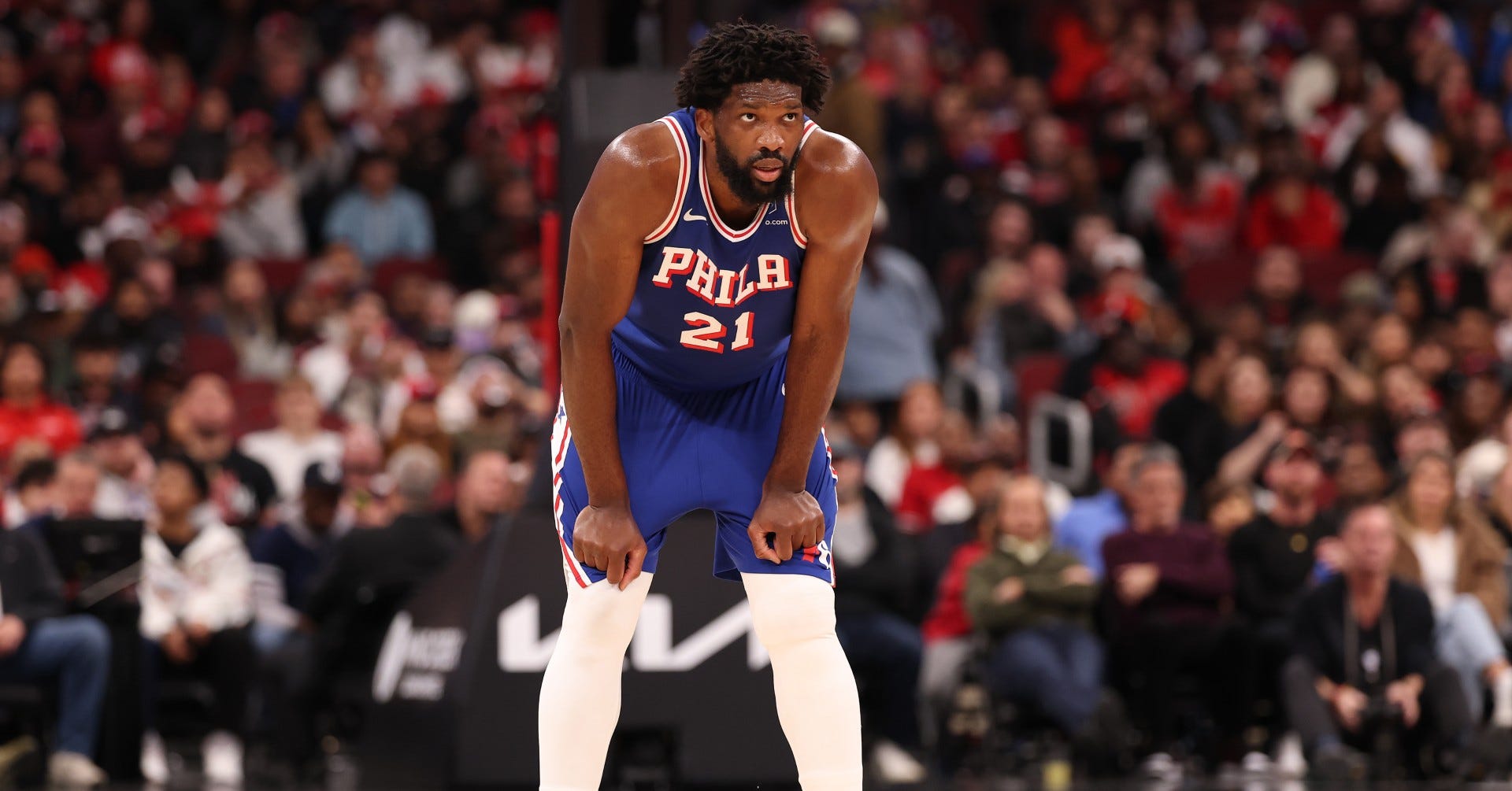
Heading into the season, you could’ve found expectations all over the map for Joel Embiid. Some optimistic fans saw the off-season workout footage of Embiid and wondered if he might be all the way back. Other fans, more disillusioned with Embiid, likely expected him to continue to decline in terms of quality of play, and to once again struggle to stay in the lineup.
Based on the trajectory Embiid had been on for the past 18 months heading into the season, you couldn’t really disregard the latter group of fans as totally crazy. Embiid’s struggles last season were the type of issues that star players – star big men, in particular – rarely rebound from.
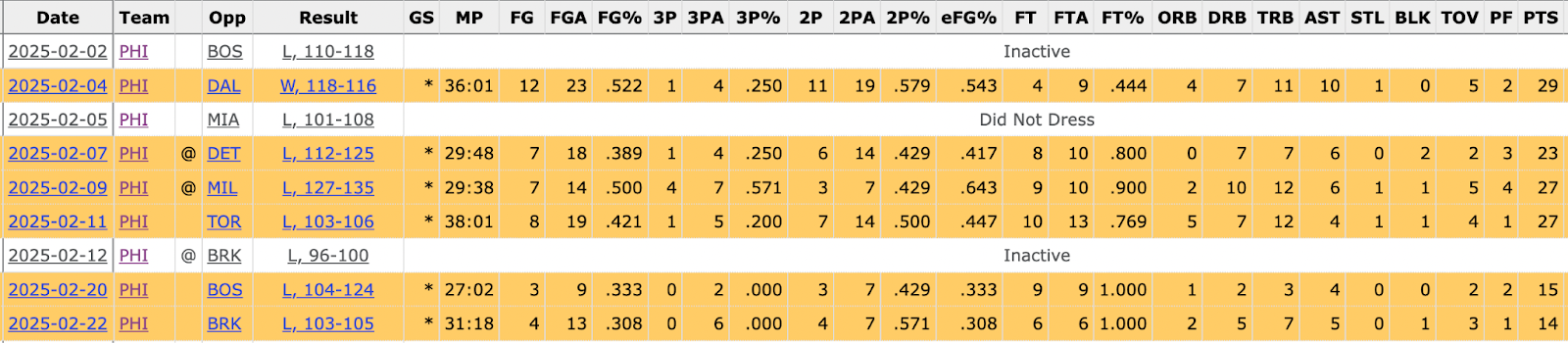
In that 2024-25 season, Joel Embiid played just 19 games, divided into three separate stints – one in November, one from mid-December to early January, and one in February. And while there were moments of brilliance and his numbers were never outright terrible, each stretch of games for the big fella followed a similar pattern: he looked roughly like his usual self upon returning, and slowly looked worse and worse over the course of several games until he became completely unable to play.
This pattern was most obvious in Joel’s final stint in February. He posted a 29-point triple double in his return against the Mavericks on February 4th, but five games later against Brooklyn, he could hardly get up and down the floor as he posted just 14 points on 4-13 shooting in a miserable loss to the tanking Nets. Embiid was shut down for the year shortly thereafter.
Just 10 games into the season — only six of which he’s actually played in — it’s still far too early to take any conclusive victory laps on Embiid’s health. But any discussion of Joel’s season so far should start here: The simple fact that he has been able to play six games this season without his production and overall mobility visibly tailing off is a positive sign. A small feat? Sure. But one that he could not accomplish nine months ago.

In fact, if anything, Embiid has gotten better with every game he’s played this year. After a stinker on opening night in Boston, he’s put up 20+ points in every game he’s played since. He’s up to 19.7 points per game on just 23 minutes per night. After an off-season where many (including myself) asked him to consider shifting into a role resembling a souped-up Brook Lopez, he has clearly exceeded that. He is still a star-level offensive player. He has carried the offense for long stretches, including his 18 point first half against Chicago and his 16 point second half against Toronto. Keep everything the same for the next few months – the frequency of his play, the statistical output, and even the minutes restriction – and Embiid would have a real case for making the All-Star team. Long way to go, lots can change, etc. etc. But I think Sixers fans should feel thrilled with how he looks so far.
That said, Embiid’s play has of course been inconsistent, even from quarter to quarter. Tuesday night’s loss against Chicago, in which he scored just two points in the second half, was probably the best example of that. After dominating the first half, a visibly fatigued Embiid struggled to score on Nikola Vucevic (who he has always dominated) and stagnated the offense en route to a crushing loss. In that sense, despite all of the promise that Embiid is showing, that loss should still serve as a lesson for the immediate future: becoming overly reliant on the big fella to carry your half court offense is still a dangerous bet. Even when Embiid is dominating, it should ideally feel as though it’s largely coming within the flow of the offense. Any stretch where Embiid carries them should be looked at as gravy. Relying on him to do that for full games is foolish.
And while I’d love to be proven wrong, I don’t think that distinction is primarily about conditioning or rhythm. Embiid has clearly lost a good chunk of athleticism from where he was at his peak. He’s still obviously able to rely on his shooting touch, size, coordination, and basketball IQ to get him to a star-level statistical pace, but he no longer has the top-end explosiveness that allowed him to get to that MVP-level, 35-point-per-game scoring clip.
There will continue to be a feeling-out period between Embiid and the rest of the team in terms of what exactly they can put on his shoulders. Such is often the case for aging big men with young star guards by their side. But it is certainly clear that Embiid is still a net positive and the team is better any time he is out there. While it’s still early, I think it’s fair to give Nick Nurse some credit for how he has balanced the need to fit Embiid into the offense while still centering things around Maxey and the rest of the guards. The offense has clearly been less Embiid-centric than years past, but Joel is still putting up high-level numbers. That balance is difficult to strike, and Nurse has done it well.

Since the start of the season, there’s been a small but vocal minority of fans begging for Embiid and Paul George to be traded. The idea is that they are “in the way” of the young guys, and they would have a more clear-cut identity if they just go full-on youth movement. I find that to be ridiculous – as I said, the balance between Embiid and the guards has felt pretty smooth. It doesn’t often feel as though Embiid’s production is coming at the expense of others. After last night’s loss to Detroit, the Sixers are now 1-2 without Embiid, and you’d be hard pressed to make the case based on watching them that the Embiid-less Sixers wouldn’t be a below .500 team without Embiid. I don’t think we are missing out on anything special by not handing the keys over to Adem Bona.
The on/off numbers might show a different story – the Sixers are 4.4 points worse per 100 possessions with Embiid on the floor so far – but a huge chunk of that is being caused by unsustainable shooting luck. Opponents are shooting 4.4 percent better from 3 with Embiid on the floor, and while some of that may have to do with Embiid’s mobility issues defensively, a differential that big almost always has more to do with small sample size luck.
Overall, Embiid is playing at an even higher level and with better frequency than I’d hoped he’d be able to. He still impacts the game at a star-level offensively, his defense is improving as the season goes on, and whatever the best version of this year’s Sixers team is, it involves Embiid being on the floor and being heavily involved. If he’s able to continue to play at this rate, I’d consider it a huge win based on where my expectations were nine months ago.
Mike O’Connor is the best O’Connor in basketball writing. Previously of The Athletic, you can find Mike on Twitter @MOConnor_NBA. Mike’s writing is brought to you by Body Bio, supplements based on science, focusing on your gut and brain health.
I've been waiting for this one, Mike, and I'm glad your outlook is better than mine (admittedly biased by my overall dread over his health and his first game). If NN can figure out how to meld a 33 rpm offense like JE used to be in with the 45/72 one the current guards excel in, he should get coach of the year. Quick f/u ? what do you expect his ceiling to be on D? That is where he is most needed imo and where I'm still worried.
He and McCain should voluntarily car pool to Delaware together and build up their conditioning in low-stakes G-League games where he can gain that fitness without needing to redline himself into an injury simply because it's a close game in the 4Q and it's somewhat embarrassing if the former MVP is not on the court. There's a fine balance between using up the number of steps and jumps his knees can take and doing rehab/PT-ish activities that will enable him to take more frequent and higher impact steps and jumps but getting runs in the G-League might be good solution, despite being a completely unrealistic one from an optics perspective.